Climate Change Photos Reframe MOA Artifacts
The Trouble in Paradise installation casts new light on the Museum of Anthropology’s Pacific collections.

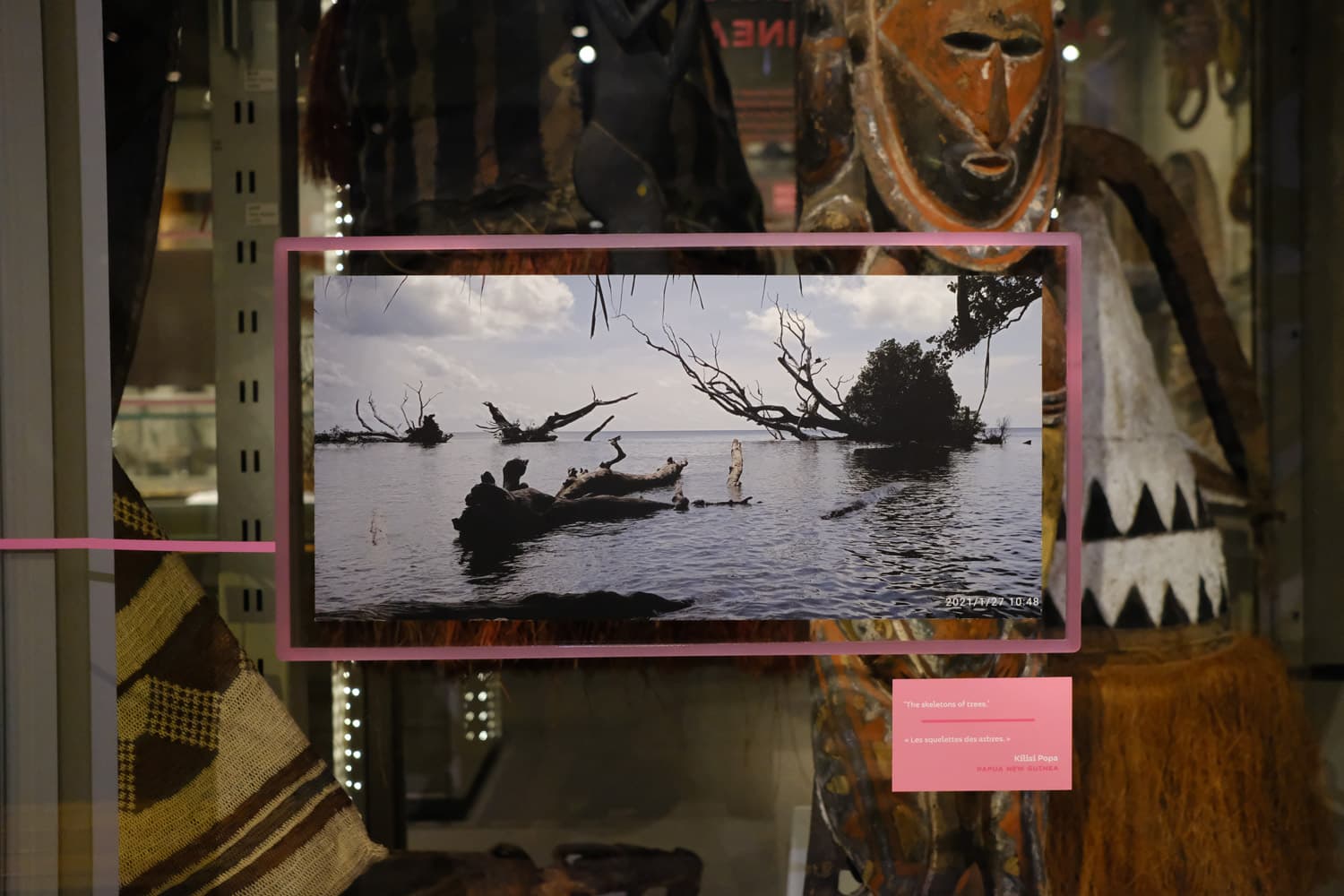
In the zig-zag of showcases at UBC’s Museum of Anthropology (MOA), something disruptive is happening. Against the muted concrete, glass, and steel of this modernist edifice glow pink acrylic frames outlining vibrant photos of flooded towns, taro farms, palm fronds, and smiling people. The photos are interspersed with descriptions and poetry in matching pink text—all pasted directly onto the glass of the cases.
This is Trouble in Paradise: Climate Change in the Pacific, a collection of photos originally commissioned by the UK Government in 2021 to coincide with the UN’s COP26 climate change conference in Glasgow. Mitiana Arbon, who curated the photos for MOA, tells me that all of it is designed to disrupt the space. An “intervention” rather than an exhibition, this version of Trouble in Paradise aims to use the current reality of anthropogenic climate change as a lens for looking at the museum’s historical Polynesian, Melanesian, and Micronesian objects. The photos and words may seem out of place, but that only draws attention to what’s out of place in our climate, and the out-of-placeness of the museum’s objects.

The first time I go see the photos, my partner Hazel and I arrive at MOA half an hour before it closes. The pink glyphs of the installation’s description float in front of wooden model ships from Kiribati and New Guinea. These objects and the photographs come from living ecosystems made vulnerable by climate change. I am struck by the irony that these objects—severed from their places of origin—sit safely in climate-controlled boxes, while Fiji floods and rising oceans threaten to swallow the Marshall Islands as a result of a warming climate we cannot control.
This juxtaposition also makes me think about where I am: on unceded Musqueam land, colonially overwritten by UBC and MOA. How just beyond this modernist concrete stretch land, coast, and water stewarded by Indigenous people for millennia.
As I wade through Trouble in Paradise, I notice the intervention changing the way I see the displayed objects and the showcases themselves. Papua New Guinean masks carved from wood stare from behind a photo of Papua New Guinean trees ripped from the ground. By a flood or by storm winds, I’m not sure. They float in water like bodies. I wonder if those masks would’ve been made from the same kinds of trees, these “skeletons of trees” as photographer Kilisi Popa calls them in their photo’s caption.
Elsewhere, a calmer image: a fan of yellow-green palm fronds against a blazing blue sky. Geoggreyna Henry, a young Cook Islander, took this one. My eyes fall to the palm frond skirts just below.
And in the midst of these, a woman’s smile catches my eye. She’s in a canoe with four other Fijians, the man in front of her standing up, paddling them through floodwater. She’s smiling so bright.

The pictures and poetry that obscure my view through the glass turn the museum’s structure itself into something to be looked at, critiqued. Without them, would I be noticing the signage as signage? Or would it fade into the background, as the objects alone—in their sterile preservation and historical remove—held my attention?
Hazel stands pensively in front of the Aotearoa (New Zealand) section. “I think about how art that sits behind glass displays just disconnects us,” she says. “It puts us into this voyeuristic relationship. Contextualizing them, physically breaking up the wall between me and the objects, immediately pulls me closer to understanding them with more depth.” The pink text tells us about each place featured in the gallery, emphasizing local spellings of place names: Solomon Aelan, Sāmoa, ’Avaiki Nui, Aotearoa, Papua Niugini, Fiji. But the text also reminds us, “Hey, there’s glass here.” To me, it makes visible the act of collecting—and the violence that can accompany it. It makes me examine by whose hands these items came here, and what the significance of their being here is. Indeed, how I came to this land and why I stay.
Curator Arbon, whose family is from the Sāmoan village of Tafua tai, Savai’i, graduated from the Australian National University, having studied museums, cultural anthropology, art theory, and Pacific studies. He joined MOA as the curator of the museum’s Pacific collection in 2024, after working as an archivist at Germany’s Übersee-Museum, and says that museums tend to “collect things as objects and place them outside of the context of time.”
With this installation, Arbon sought to “disturb what you see in the showcase.” He first saw the photo series at the National Library of New Zealand, where it was exhibited in 2021. There and in subsequent showings, the series was displayed as a traditional photo exhibit, which—like objects encased in climate-controlled glass boxes—“seriously decontextualized” the photographs.
Arbon gives me a 1-on-1 tour for my second viewing. As we drift along, he preempts each of my questions with bits of context. The intervention’s format draws attention to the museum itself as a subject of inquiry. When we notice not just the objects it houses, but also that it houses the objects, what questions arise? He asks me to consider how museums can be useful cultural repositories as well as problematic and exclusionary.
Arbon and I reach the Solomon Islands section. As we turn the corner, two human figures carved from dark wood stand in the display. The pink text above their heads tells me that the islands are home to more than 70 Indigenous languages, and how rising ocean temperatures and acidification are threatening the livelihoods of Solomon Islanders. The placard at the figures’ feet tells me that a man named Frank Burnett collected these figures from New Georgia on one of many trips to the South Pacific, doing what was called “curio collecting.” I remember finding this term curious on my first visit, and making a note to ask Arbon about it.
It turns out Burnett is part of the reason MOA exists—and that UBC has a Department of Anthropology in the first place, Arbon tells me. In 1927, Burnett’s estate was gifted to UBC. This included his 850-object collection from the South Pacific.
“It’s very strange for a Canadian institution to have a curator dedicated to the Pacific,” Arbon says. “But it’s because of that collector. Frank Burnett made his money in many different ways in Canada.” Then he bought a yacht, “like rich people do today.”Starting in 1895, he sailed his schooner around the South Pacific—large swathes of which were still part of the British Empire—gathering objects from cultures he thought were dying out. In his time, “salvage ethnography” was a guiding logic for anthropology. This worldview saw Indigenous cultures as on the brink of extinction, meaning artifacts of these cultures needed “saving.” (This attitude applied not only to cultures of the South Pacific, but also the Indigenous peoples on North America’s Pacific coast.)
I am struck by the irony that these objects sit safely in climate-controlled boxes, while Fiji floods as a result of a warming climate we cannot control.
In 1947, the year of MOA’s founding, the Burnett collection lived in a small room in what’s now the Irving K. Barber Learning Centre. Anthropologist Audrey Hawthorn was asked to curate these objects into the museum’s founding collection, as her husband Harry Hawthorn became the university’s first anthropology professor and MOA’s first director.
The current Arthur Erickson-designed MOA building opened in 1976 to house a collection that had outgrown that original building. Arbon says that this period saw shifts at MOA as the field of anthropology reevaluated the ideas behind “salvage” anthropology.
In his role as curator, he is “trying to trace the thread of logic of how the museum thinks in the ’70s, ’80s, and moving onwards,” Arbon tells me. “MOA has been well-known for how we’ve tried to rebuild relationships and rethink what a museum can be. Particularly for First Nations in the Pacific Northwest coast, we will openly repatriate [belongings], and we work directly with nations to return things for ceremony.”

Cyclone frequency has doubled in the last decade, exposing many Fijian villages to high winds, heavy flooding and sea surges.
Hazel and I can’t take our eyes off the images. They echo off each other: the coral stucco of a Sāmoan house against the rosy mirror sheen of a flooded Fijian town.
The photos aren’t by professional photographers or journalists. They’re by schoolchildren. Villagers. People of the South Pacific who face climate change as an immediate existential threat in their communities.
We reach the poem 2 Degrees by Marshallese writer Kathy Jetñil-Kijiner, which graces the corner of a tall display case. The poem starts high; we crane our necks to start reading.
The poem compares the 99.8ºF fever of the author’s child, technically one degree below the 100.4ºF temperature her doctor tells her is an actual fever. She writes:
what a difference
a few degrees
can make
Then, further down:
At a climate change conference
a colleague tells me 2 degrees
is an estimate
I tell him for my islands 2 degrees
is a gamble
The beginning of the poem is located two metres off the floor, Arbon tells me: the average elevation of the Marshall Islands above sea level. “A lot of Kathy’s poetry is very existential in the discussion around climate change, because for her, two degrees isn’t ‘Oh, we’ll have to move.’ It’s the potential destruction of Marshallese culture,” Arbon says.
“We often are saturated with statistics and numbers and chemistry,” Arbon says. But with Trouble in Paradise, Arbon wanted viewers to feel the emotional impact of experiencing climate change.
For Arbon, poetry helps capture that feeling. The inclusion of poems “reminded me of this saying that we have in Sāmoan that translates roughly as ‘stones decay, but words don’t.’”
Near the end of the tour, Arbon brings my attention back to the pink acrylic frames and vinyl text. Some of the vinyl and all of the acrylic were sourced from leftover materials MOA had lying around, he tells me. This is a small example of how the museum is trying to make its operations more sustainable, in addition to reimagining its role as an institution.
Arbon and I sit down below a three-metre-long hammerhead shark sculpture made from discarded fishing nets that’s suspended from the ceiling. Wrought tangles and swirls of beige, brown, and olive plastic give form to a being to whom these zig-zagging corridors are a body of water to swim through.
It was made in 2017 by the Erub Arts Collaborative, a group of Indigenous and non-Indigenous artists based on small Erub Island, just north of Australia. This piece is also in conversation with the showcased objects, photographs, and poetry.
I sit and look up. Then ahead, and around. If and when you visit, make sure you look slowly, in all directions. Take time to see the connections between image, word, and object as you wade through paradise.
Trouble in Paradise will be on display in the Multiversity Galleries at the Museum of Anthropology on UBC’s Vancouver campus through August 2026.
This story was first published on The Green House, our membership platform. Join us there for early access, discounts and freebies, community discussions, and to support our work telling the large and small stories of how we can live sustainably.