Climate Scientists Navigate the Storm of NOAA Cuts
Months after Trump’s devastating budget cuts, researchers in the US and beyond are finding new paths to information-sharing.

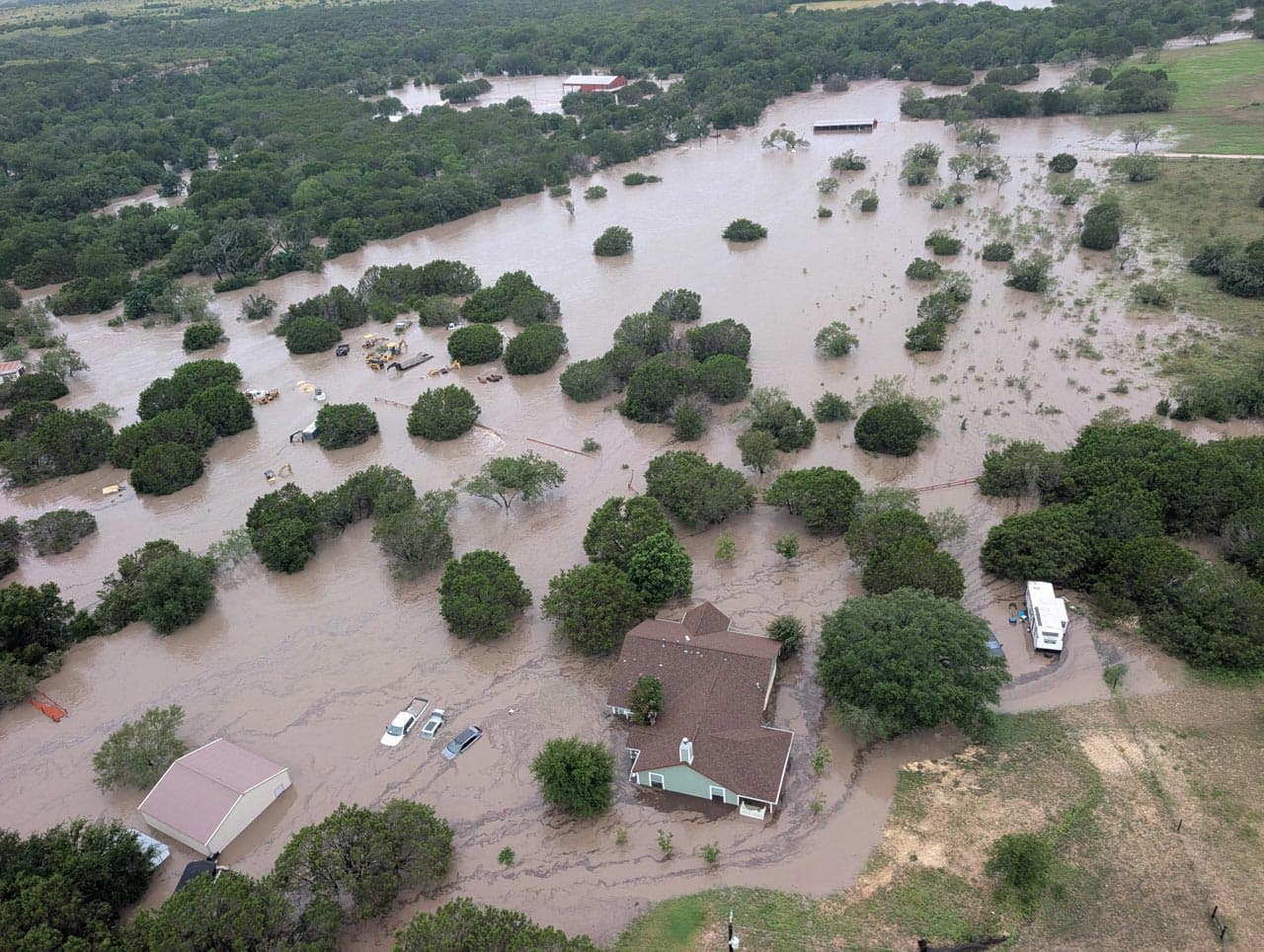
Experts believe the Trump administration’s cuts to US National Weather Service staffing made July’s flooding of the Guadalupe River in Texas more deadly than it might have been.
When the Trump administration began slashing the budgets of US federal agencies earlier this year, many employees found themselves at the centre of a vicious (metaphorical) storm. For Alan Gerard, a meteorologist at the National Oceanic Atmospheric Administration (NOAA), the cuts meant he and his colleagues would have a harder time helping others weather literal storms.
“Most meteorologists are in the profession to try to improve society and make people have resilience and preparedness—whether [for] hurricanes, tornadoes, or flash floods,” said Gerard in a telephone interview.
Under proposed cuts, NOAA’s 2025 US$6.6 billion budget would be reduced by US$2 billion for 2026, and the agency’s research arm, the Office of Oceanic and Atmospheric Research (OAR), would be entirely eliminated. After decades of functioning as a hub of research into weather forecasting and climate, NOAA is set to eliminate more than 2,000 positions in 2026 after already laying off a similar number in February and March of this year. (The NOAA website currently states that the agency has 12,000 employees, but hasn’t updated that number since March 5).
The cuts to NOAA’s budget will have impact beyond the US, however, as scientists around the globe rely on data from the agency to understand our shared climate and how human activities affect it. For instance, NOAA supports about half of the world’s oceanic monitoring research. As scientists in Canada and beyond begin to feel these impacts, though, new opportunities for collaboration and data-sharing are emerging.

Established within the Department of Commerce in 1970 under President Richard Nixon, NOAA was a merger of several agencies, including the Weather Bureau and the United States Coast and Geodetic Survey. The agency currently consists of six services: the OAR; the National Weather Service (NWS); the National Ocean Service; the National Environmental Satellite, Data, and Information Service; the National Marine Fisheries Service; and the Office of Marine and Aviation Operations.
For Gerard, who started as an NWS meteorologist in 1990, the agency’s importance lies in decades of technological developments with worldwide impact, including the Doppler weather radar network, improved computer-based climate modeling, and automated weather observation systems. Despite the importance of this work, he decided to end his 35-year tenure at the agency when the Trump administration offered early retirement as part of its efforts to reduce the workforce.
“It made sense to just go ahead and retire,” Gerard said, “and ensure that somebody earlier in their career could potentially keep themselves employed.”
Within months of the cuts being announced, climate events in the US had disastrous effects.
But of course the impacts of the budget cuts go far beyond the agency’s employees. Within months of the cuts being announced, climate events in the US had disastrous effects that some reports say could have been mitigated with proper NWS staffing. Examples include the July flooding in Texas where the absence of a senior hydrologist or warning coordination meteorologist at San Angelo’s NWS office might have delayed the state’s response, while the worst of the destruction caused in Alaska by October’s Typhoon Halong could have been mitigated, experts suggest, if the local weather balloon network had been active.
According to a report from the non-profit organization Climate Central, climate disasters between January and June 2025 had already cost the US more than US$101 billion and resulted in 174 deaths. In a world where natural disasters are more frequent, Gerard believes the importance of agencies like NOAA only grows.
“If the US—which has been one of the leading entities as far as supporting research into understanding our climate—is reducing our investment,” he said, “it really impacts global understanding of hazardous weather events and potential tools we can be developing to help mitigate those disasters.”
Patrick McCarthy—president of the Canadian Meteorological and Oceanographic Society who worked as a meteorologist at the Meteorological Service of Canada for 32 years before retiring—agrees. “Canadian oceanic and atmospheric research will be affected,” he wrote in an email. “Without [NOAA] resources, Canada’s contributions to critical science will be more limited.”
One major resource NOAA shares with global researchers is the data from a pair of geostationary satellites directed at North and South America, which record observations as frequently as every 30 seconds. Satellites like these have been used for decades to track natural disasters such as hurricanes and wildfires.
Dr. Tianjia Liu—an assistant professor in the University of British Columbia’s geography department—researches wildfires and air quality.
“I still use a lot of NOAA data, mostly the satellite data to track wildfires and smoke,” said Liu in a telephone interview. “So if NOAA … starts to end some of these services to upkeep all of that data, or even some of the models, then we might see that data degrade over time as well.”
Between January and March of 2025, Canada alone saw an increase of 41% in job applications from US scientists.
“There’s a lot of expertise at NOAA on fires and air quality, so [researchers worldwide] would lose decades of knowledge on those subjects,” Liu went on. Her work benefits not only from NOAA data, but collaboration with its staff. “When we’re using these data products, we sometimes consult with NOAA researchers to see how we should use that data, or how we should interpret these results.”
Some of the forthcoming gaps in climate data may have to be filled outside the US, potentially with the help of American scientists. A report published in Nature earlier this year found that between January and March of 2025, Canada alone saw an increase of 41% in job applications from US scientists compared to the same months in 2024.
Another, bleaker, possibility is that fewer scientists will pursue careers in climate research. “There’s a chance it might not seem like a stable career anymore,” said Liu. “Back in the day, you could be at a federal agency for decades until retirement … but now there’s just a lot of uncertainty.”
Speaking of his fellow meteorologists, Gerard stated that “Hopefully, NOAA will be the place where they can make [a] contribution. But if and when they become concerned that it’s no longer the place for them to make that contribution, I do think there are other non-governmental and private organizations that are starting to step up and fill some of these gaps.”
One example is Climate.us, which launched in August of this year as a non-profit successor to NOAA’s defunct Climate.gov website. The earlier website was one of the casualties of the cuts in the first half of 2025, when Trump-appointed officials at NOAA shut down its daily operations and redirected the URL to the main NOAA.gov website, permanently deleting some posts, reports, and blogs containing climate information in the process.
The new site was created by a group of former Climate.gov team members who, with support from the nonprofit fiscal sponsorship organization Multiplier, have built an online home for documents taken off the government site—like the Fifth National Climate Assessment—as well as new climate explainers, in-depth news features, live trackers of climate events, and a climate literacy guide. Climate.us’ mission is to protect climate data from political interference and keep it available for researchers and scientists as well as making it accessible to the general public. It is not currently clear where Climate.us might source new climate data if NOAA stops gathering and sharing it.
Gerard himself took initiative in March by launching Balanced Weather, a daily Substack newsletter where he comments on and discusses climate events for an audience of fellow climate scientists and regular folks. In his introductory post, he wrote: “I deeply believe that a significant need in society today is for reasoned, rational and scientific perspective on critical topics like weather and climate.”
This story was first published on The Green House, our membership platform. Join us there for early access, discounts and freebies, community discussions, and to support our work telling the large and small stories of how we can live sustainably.