Imagination Forges Connections to Creation
By encouraging kids’ sense of wonder, we rebuild our own connections to spirit and land.

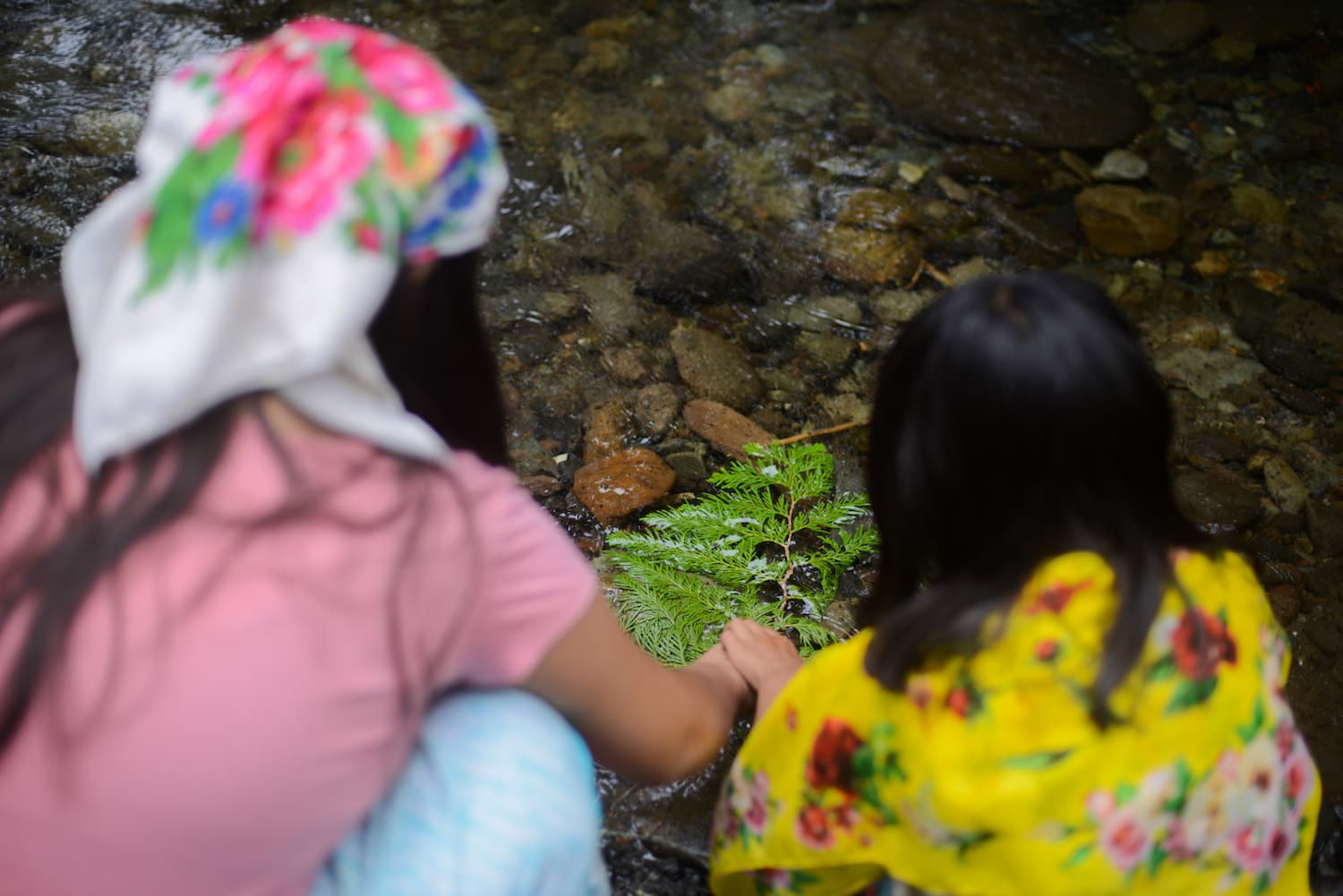
smuqaken Marchand, 16, shows her niece, pl̓pal̓wícyaʔ Marchand, 7, syilx teachings of water motion, showing her how the bough moves in the water and what it does for the spirit.
The morning mist still clung to the grass when we began work that morning, 15 years ago. Four preschool teachers moving quietly through the predawn light, our breath visible in the crisp air as we arranged tiny treasures beneath the oak growing in the corner of our schoolyard. Cedar boughs we had just picked at a nearby creek formed a fragrant carpet. Heart-shaped gems caught the first light. Miniature plates held invisible offerings. Then, the final touch, a winding trail of glitter led from the school doors to this enchanted space we’d created.
“Aaaah, the fairies came, the fairies came! There are sparkles everywhere!” The children’s voices erupted in wonder as they burst outside for morning play. Their small feet danced along the glittering path, eyes wide with the magic of discovery. For them, there was no question, the fairies had visited. The evidence sparkled beneath their sneakers.

As I watched their faces, alight with that particular glow children get when the world reveals its magic, I realized we weren’t just building a fairy garden; we were constructing a bridge between worlds. It’s a bridge that Indigenous cultures all over, including my nation, the syilx (pronounced SEE-ulh, where you pronounce the “h” sound after the “l,” and known colonially as the Okanagan), have always known how to cross.
When children are closest to Creation
In my early-childhood-development training, we studied the neuroscience of young minds, and how neural pathways form at lightning speed, creating the foundation for all future learning, behaviour, and mental health. The textbooks called the times when this happens “critical developmental windows.” But my syilx Elders recognized it as a sacred time when children stand closest to kwulencuten (kwool-en-CHOOT-en), the energy of Creation itself.
Elder Auntie Linda often reminds us, “Little ones haven’t forgotten how to listen to the land yet. Their ears still hear what ours have been trained to ignore.” Modern psychology might call this “magical thinking,” but in our teachings, it’s simply accurate perception. For example, where adults see an empty meadow, children see the swaying forms of unseen relatives.
That fairy garden became more than a playful activity, it was an act of cultural preservation. By encouraging the children’s natural communion with the unseen, we were honouring sqilx’w (SKAY-ulh, meaning “Indigenous”) ways of knowing that have been systematically suppressed by colonial education systems. When 4-year-old Kiya insisted she saw tiny footprints near the berry offerings, we didn’t correct her. We asked, “What do you think the fairies wanted to tell us?”
Her answer was, “They’re happy we remembered them.” We responded with a nod of recognition.
The medicine of re-creation
There is a particular magic in creating for children what we once longed for ourselves. Maybe it’s the way you hide handwritten notes in their lunchbox because no one did that for you. Maybe it’s the way you build blanket forts with them, just to feel the thrill of that secret hideaway you never had. This act is not just nostalgia, it is reconciliation. It is the grown-up version of you whispering to the child you once were, saying, “I see what you needed. I can give it now, even if it’s through someone else.”
This is the heart of adult play, an often overlooked necessity—as critical to our well-being as sleep or nourishment. Play is not frivolous. It is how we process, how we remember who we are beneath the weight of bills and deadlines and responsibilities. It is how we return to our essential selves.
Psychologists say that this is one form of “re-parenting,” giving little ones the joy, security, and wonder we may have missed ourselves. But sqilx’w teachings take it further. Play is not only a form of therapy, it’s ceremony. When we kneel in the dirt arranging tiny plates for fairies, we’re not just playing, we’re remembering. We’re realigning ourselves with the truth that the world is alive, layered, and full of beings seen and unseen.
I saw this transformation in my coworker, who was a survivor of the Sixties Scoop—when about 20,000 Indigenous children in Canada were taken from their families and placed in non-Indigenous adoptive families—and had been severed from her Nehiyaw culture and community. As she carefully placed a miniature cedar-bark canoe near our fairy garden’s “stream” (a winding line of blue fabric), her hands began to shake.
“My kokum [grandmother] used to tell me stories on our visits about the Little People who lived in the rocks,” she whispered. “I hadn’t thought of that in 30 years.” The act of creating magic for children had become medicine for her own inner child.
The act of imagining a better world is the first step in manifesting it.
This is why adult play is just as vital as child’s play. Whether through video games that let us safely navigate challenges, art that externalizes our inner landscapes, or hiking that realigns us with natural rhythms, play brings us back into right relationship with Creation. syilx Elders teach that the Spirit World isn’t “somewhere else.” It’s here, woven into the reality of the everyday, waiting for us to perceive it. When we allow ourselves to get lost in play, we’re not being childish, we are in fact practicing a type of sacred attention.
In syilx epistemology, the land speaks. The rivers, the fir trees, the coyotes, the stones, they are all relations, and they communicate through dreams, visions, and the stories passed down through generations. Imagination, then, is not make-believe, it is the act of tuning into the time and place you are standing in, becoming one with the energy of place. When you learn to collapse time and place in this way, you become one with the tmixʷ (t-mee-UH, which translates roughly to the spiritual energy of all animate and inanimate beings), understanding you too are tmixʷ.
The act of imagining a better world is the first step in manifesting it. We are opening the door to the Spirit Helpers, to the ancestors, to the versions of ourselves that coexist across time and space.
Where storytelling meets quantum physics
The more I study quantum physics, the more I realize it’s describing the same reality as syilx captikʷł (oral storytelling laws, pronounced something like chap-TEEKH), just in different languages.
In syilx science, the observer doesn’t stand apart from whatever they’re observing. Imagination isn’t separate from reality, it’s how reality shapes itself. This is why dismissing children’s visions of fairies or spirit animals isn’t scientifically sound—it’s a cultural bias that limits our perception of reality’s full spectrum. It speaks to the syilx knowledge that we are beings existing in a spiral of many worlds at once, so we are responsible for how we engage with them.
Quantum physics says that some particles exist in multiple states simultaneously until observed, suggesting that reality itself is participatory and responsive to consciousness. This mirrors syilx teachings that perception shapes our experience of the world and that unseen dimensions coexist with our own. Just as Indigenous knowledge systems have long understood that observation is a sacred act of relationship (where listening to the land changes both the listener and the land), quantum physics demonstrates that at the most fundamental level, the observer cannot be separated from what is observed.
Quantum physicists and syilx Knowledge Keepers agree: nothing is truly separate, and wonder is the most accurate response to existence.
When children see fairies or when we speak to Spirit Helpers, we’re not imagining fiction but engaging with layers of reality that non-Indigenous science is only beginning to map—a world where, as both quantum physicists and syilx Knowledge Keepers agree, nothing is truly separate, and wonder is the most accurate response to existence.
So, when syilx storytellers recount the adventures of senklip (SIN-kleep, Coyote), they’re not just entertaining, they’re activating a living field of relationships. As children imagine Coyote’s antics, they’re not fantasizing, they’re practicing the ceremonial observation that maintains a balance between the many worlds. This explains why, in our preschool program, children who regularly engaged in imaginative play demonstrated not just enhanced creativity, but what we call “spiritual discernment”: the ability to sense energetic truths beneath surface appearances.
The Eurocentric world often dismisses imagination as frivolous, something to outgrow. But cutting-edge science like quantum physics—with its teachings of multiple universes and observer-shaped reality—shows what Indigenous cultures have always known: there’s more to this world than meets the eye. When children see fairies, or when we feel the presence of Spirit in that warm summer wind, we’re not hallucinating. We’re perceiving.
Ceremony in the everyday
The most powerful spirit work isn’t only reserved for sweat lodges or longhouse ceremonies; it’s embodied in our everyday life. Building blanket forts becomes ceremonial world-building. Baking cookies transforms into offering-making. Even something as simple as hiding love notes in a child’s lunchbox is akin to the way we as syilx peoples leave offerings for the unseen. For instance, we have specific ceremonies to show our gratitude to the Sacred Beings that caretake our homelands alongside us as sqilx’w.
Today I think of Kiya, now 18 years old, who recently told me she still leaves tiny offerings under her backyard cedar “just in case.” And I carry my colleague’s transformation, the way rebuilding fairy gardens helped her rebuild a connection to the stories stolen from her.
This is how culture survives, it’s in these small, sparkling moments where you experience a glimmer of remembrance. When we kneel to peer under toadstools with wide-eyed children. When we pause our busy adult lives to really listen to the wind through pine needles. When we choose, again and again, to believe in the spirit of wonderment that systems of oppression have tried to remove from us. And when you finally glimpse that flicker of movement at the corner of your eye, that shimmer you’d have dismissed yesterday, you’ll understand.
This isn’t imagination. There is a whole world calling.
This story was first published on The Green House, our membership platform. Join us there for early access, discounts and freebies, community discussions, and to support our work telling the large and small stories of how we can live sustainably.