Matchmaker for the Planet: A Q&A with Kendra Fanconi
The David Suzuki Foundation’s first artist in residence wants to help people fall in love with the world around them.

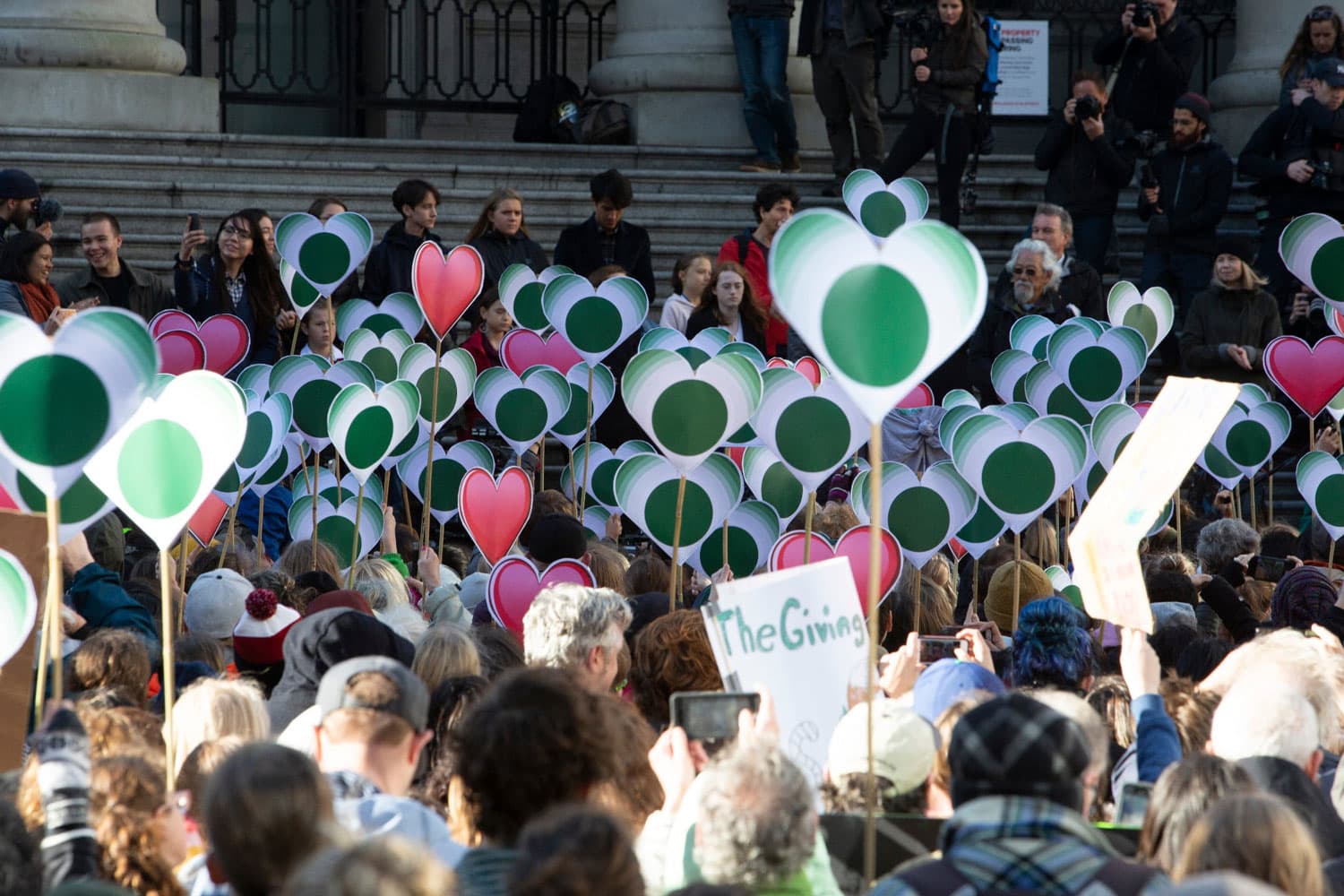
Greta Thunberg, David Suzuki, and the youth suing the Canadian government over climate change face the Artist Brigade’s “Sea of Hearts” at a Vancouver rally in 2019.
Kendra Fanconi—a theatre artist from shíshálh territory on BC’s Sunshine Coast—recently started working as the first artist in residence at the environment-focused David Suzuki Foundation (DSF). Trained in theatre and ecorestorative art, Kendra co-founded (and for 18 years led) The Only Animal, a company that makes theatre rooted in place. She was the lead artist on many shows that won Jessie and Betty Awards (the Tonys of Vancouver and Calgary, respectively).
In 2023, The Only Animal also received the inaugural Green Award from the Professional Association of Canadian Theatres. The following year, Kendra was one of the 13 artists to receive the DSF’s first Rewilding Arts Prize. The award periodically honours multiple Canadian artists whose work restores connection with the natural world.
In the early days of her DSF role, she is meeting with foundation staff to find out “where art can help.”
“I see myself as a gardener here,” she wrote in an email, “and I have everything to learn about what is currently here, what the environment is like, the conditions, what is already planted, what is thriving.”
In addition to her residency with the DSF, she is currently exploring the possibility of a similar role with an academic institution. She hopes to connect artists to the power of ecorestorative art-making and work toward a paradigm shift in how we see ourselves as part of an ecosystem. This interview has been edited for length and clarity.

Niamh Burns: What is the artist in residence program at David Suzuki Foundation?
Kendra Fanconi: The program is brand new, but it comes from about a decade of talking and working together. [Director of Engagement] Sherry Yano came to me probably a decade ago, and we were talking about the Sunrise Movement, which was at that time a new environmental youth movement in the US. And she said, “One of the pillars of the Sunrise Movement is arts. I think we need arts here at David Suzuki Foundation. The fact-based approach is dead.”
This old idea of climate communications—that if we knew better we would do better—it’s just not true. And we have like 40 years of proof that behaviour change doesn’t come from more facts and information. So what does promote change?
Sherry at that time said to me, “What we need is an artist brigade.” And it struck me in such a deep way. Later, at the company I used to run, we formed an artist brigade: 100 artists in Vancouver who wanted to be working on climate and environmental issues in their practice and weren’t. It really taught me that there is this enormous potential in art and in artists who are trained in all manners of animation and delight.
The climate crisis at its very basis is about disconnection: from each other as humans, from our ecosystems, from plants and animals. How do we knit the kinds of connections that will lead to behaviour change?
I want to make you fall in love with the forest, with the ocean, with your neighbours, and with this idea of planting a culture of care.
[I] see the role of art really as making invitations to audiences of all kinds to get connected and fall in love. The work, as I see it, is really the work of a matchmaker. I want to make you fall in love with the forest, with the ocean, with your community, with your neighbours, with green spaces, and with this idea of planting the impulse for stewardship and a culture of care.
[After] we had all of these conversations, Sherry reached out and [asked], would I pilot an artist in residency position?
The work for David Suzuki Foundation is very much about meeting with anyone who wants to meet with me from the organization. I want to ask the questions: “What is the heart of the work?” and “What is the heartache of the work?” Because I think art lives in those spaces.
When I was reading through their website, I was so overwhelmed I had to go to the kitchen and deal with figs off my fig tree to calm down from the catastrophes. And so I came back and reflected about [adding] an art piece that helps, right on the website. Like a sidebar by an artist—“Feeling Overwhelmed? Click Here.”—a little bit of space to digest and process and feel your way into these momentous facts that you’re reading.
That sounds like part of [the work] is having art help people through climate grief and anxiety, is that right?
Yeah, it’s really present. Even ten years ago we weren’t thinking about it as much as we are now. I’ve noticed that shift in the climate art space.
Art has such a powerful way to speak that isn’t overwhelming, or, if it is overwhelming, it can be cathartic.
Let me tell you the story of the Sea of Hearts, because it’s one kind of interaction that was not expensive, and it was really fun and, I think, effective. In 2019, Greta Thunberg was crossing Canada and speaking at these rallies, and she was going to come to Vancouver. David Suzuki Foundation was helping support it, and at the same time they were launching the lawsuit where 15 Canadian kids were suing the Canadian government for the right to a liveable future.
Some of these kids were like 11 years old, and they were terrified to face the crowds that were expected to come because Greta Thunberg was speaking. So the question Sherry Yano reached out to me with was, “How can we get the crowd to show the kids support?”
We had a week and a budget of C$2,000. So what we did was we made 1,000 of these pop-up hearts. The idea was that we would distribute them and train the people who were standing in the crowd: when you hear something you love, you pop the heart up in the air. Kind of an analog way of putting a heart on something like you would on Instagram.
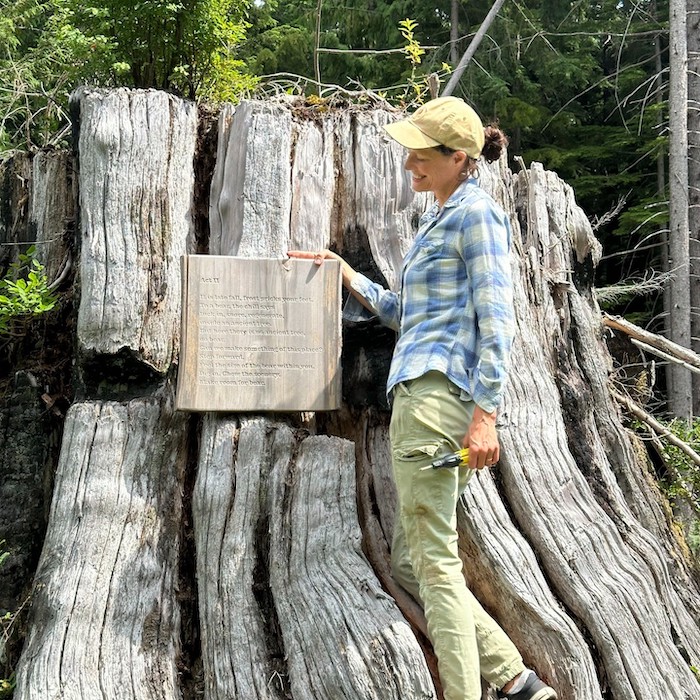
Kendra Fanconi takes down a piece of the “1,000 Year Theatre” installation in order for it to be displayed at Ottawa’s Museum of Nature alongside work by other Rewilding Arts Prize winners.
This sea of hearts began to reflect the place of love and connection in the movement. It became a talking point, a theme that we’re all connected with, as well as something that made the kids kind of laugh and relax a little more.
That piece catalyzed the idea that art could do something really special without a huge investment in resources and rehearsal time and materials. When I go into the meeting rooms at David Suzuki Foundation, people still have their hearts on their office walls since 2019. It’s a meaningful metaphor to put in people’s hands: we’re here because we love something.
There needs to be a little bit of levity in those spaces, because [this work and the climate crisis] can be just so unrelenting.
That’s coming up with David Suzuki Foundation as well. That burn-out amongst organizers is common, and it’s hard work. So how do we actually turn that impulse for care back onto those people who are doing all of that hard work? It feels like a little loop of sustainability within that larger loop of sustainability.
I think the activists don’t know how much artists want to get in, and artists don’t know how to get in. And so David Suzuki Foundation says, “Oh, if we had an artist in residence then we could start to build that relationship.” But ultimately, I think it’s about a big network of artists plugged into a big network of scientists and a big network of activists to create change.
I’m working with an academic institution that I won’t name in this interview [because the relationship hasn’t been formalized]. I sat down with this dean and [asked] “What would you really like as an outcome of having an artist in residence?”
And he said “I would like to see a paradigm shift in how the environment is seen by the general population.” I was like, “Wow! Yes, yes, paradigm shift, absolutely. How do we do it? What resources do we need? How do we engage and get going?”
Absolutely, that’s what we need to do. And I know that spirit exists at David Suzuki Foundation too.
Is that what you hope to accomplish? Paradigm shift?
It feels pretty overwhelming as one person to say that. That’s why, when I think about engaging as an artist in residence, I don’t think about me creating pieces. I really think about how to engage as many artists as I can into as many places as I can.
And I think we know that the environmental and climate crisis is exponentially getting worse. So let’s think exponentially when we think about creating that kind of change. It will take a paradigm shift for us to create a culture of stewardship. But when I see how quickly things can grow really terrible, I imagine that as quickly things can become much better.
Are you open to artists reaching out to connect and create?
They can find me on my own website, which is theonlyfanconi.com. I’m always looking for artists in any discipline who are inspired to do this work. I don’t know yet what the opportunities will be, but I love meeting artists and learning about their work. So yeah, big yes!
This story was first published on The Green House, our membership platform. Join us there for early access, discounts and freebies, community discussions, and to support our work telling the large and small stories of how we can live sustainably.