Meet a Lumbering Giant on Granville Island
In Me & the Forest, a Korean-Canadian tree puppet connects with young and old.
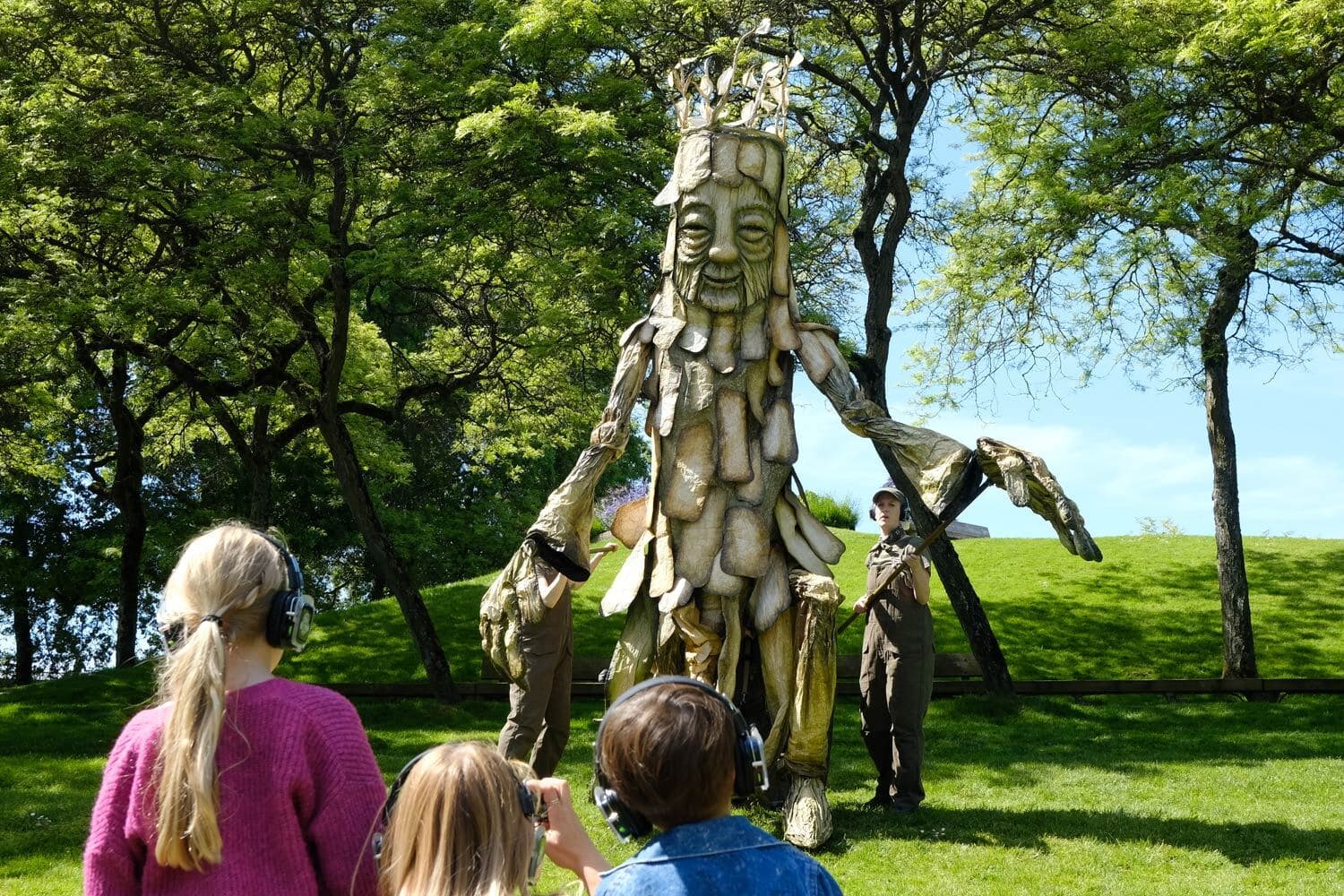
The five-metre-tall Mitig comes to life in Ron Basford Park.
There’s a special tree in Granville Island’s Ron Basford Park. Unlike the dainty cherry trees that line the park’s perimeter, this one is large and stocky. It also has a face, on which it wears a sage smile, kind eyes creased by the ages. And until mid-June, you’ll be able to see it move and hear it speak.
This walking, talking arboreal giant is named Mitig, the Anishinaabe word for tree. In Me & The Forest—a co-production between Vancouver indie theatre company Boca del Lupo and Korean puppet masters ArtstageSAN—Mitig is the first member of a plant species we humans ever get to talk to and understand.

I meet Mitig for the first time on a sunny Wednesday in late May. I’m seated with around 30 others at the base of a big, grassy hill that today serves as a stage. Each audience member is given a pair of wireless headphones, which Boca Co-Artistic Director Jay Dodge says is our “telepathic” means of understanding Mitig.
Music fades in. Bright synthesizers, lustrous violins, and what sounds like glimmering chimes. Then, Mitig’s thunderous voice.
He lumbers down the hill to meet us, incredulous that we humans seem to be able to hear—let alone understand—him. He’s as awestruck and curious as we are, it seems. He chants, sings, and cracks some cheesy jokes, like many elders we might know. Then, he wonders out loud: “Why now? When we are on our last leg?”
This question is asked partly in jest, as Mitig goofily balances on one leg, waving his large branches in the air. But the grief it’s laced with hits me unexpectedly hard.
In creating this show, the team thought about “the gravity of what’s around us and what we may have lost connection to,” says Sherry J. Yoon, Dodge’s co-artistic director. After the performance, she tells me about how Mitig sprouted from asking what would happen in human society if parts of the natural world like “trees, whales … actually had identity and station?” For Yoon, it was important to bring both young and old along for an exploration of these questions.
“When interspecies communication becomes a reality,” the show’s webpage quotes Dodge, “[…] it will be like aliens landing on the planet and we will have to rethink our self-appointed status as the sole sentient species.”
Mitig lumbers down the hill to meet us. He’s as awestruck and curious as we are.
The project began in 2023, when Boca del Lupo first met with ArtstageSAN, a Korean puppet-theatre troupe led by Ru Ji Yun and Jo Hyun San, in Seoul. Founded in 2001, the company has toured internationally since 2009 and helps run the Chuncheon World Puppet Festival, where Me & The Forest will head on tour in September.
After pandemic restrictions had shut down live theatre in Vancouver and the rest of the world, the production’s creators imagined this project as a way of bringing people back for what Yoon calls “an undeniable moment together.” Development continued over three years, with workshops held in both Seoul and Vancouver. Yoon tells me that Me & The Forest is the first part of a trilogy the companies will collaborate on. After this piece addressing the land, the following parts will focus on the ocean and the sky.
Interconnectedness is a thread that runs through the project. Audiences are connected across age groups, and the trilogy connects earth, water, and air. Mitig himself speaks about how the Birch, Cedar, and Spruce clans are all connected through the underground fungal mycelium network.
And the show’s versatility can connect the different places it will be performed, too. “[Mitig] is adaptable,” Yoon says. “There’s interest in other places for him already, and it’ll be very urban.” These different settings will provide their own distinct contrasts to Mitig. For me, seeing him with other trees feels like a part of a forest has come alive. In a dense city, though, I can imagine him being a stark reminder of the other life forms our built environments can separate us from.
Mitig is puppeted by five performers, one handling each of his limbs and one carrying his massive trunk. He was designed and built by Ru, and Jo helped with the internal structure and mechanisms.

Korean tal at Gwangjang Market in Seoul
I tell Ru that Mitig’s face reminds me of a tal (탈, a traditional Korean mask) and she finds it amusing. Mitig’s design, she says, was actually inspired by the Canadian wilderness. In particular, nurse logs—fallen trees and stumps that provide support for new seedlings as they decay—informed his look. She supposes that, because she’s Korean, elements of her culture ended up bleeding into the design, somehow.
Yoon agrees with me, that his face feels Korean. Ru adds that while making Mitig, she was also thinking about the concept of dangsan-namu (당산나무, village guardian tree): large trees in Korean villages that serve as gathering places and sites for prayer.
This talk of Korean villages, trees, and Mitig’s wise old face reminds me of my late grandfather. He was an avid gardener and keeper of bunjae (분재, bonsai). In the last photo I took of him before he died, he’s standing in his bright green garden, smiling gently, amused at me wanting to take his portrait. His face is dotted with sunlight filtered through a canopy of grapevines.
It’s all a strangely intimate and comforting experience.
There’s something about this show that feels personal to me. Not just in that I’m reminded of my grandpa, but because of the sensory experience itself. Even though I’m sitting in a public park in one of the busiest tourist destinations in the city, as soon as I put the headphones on, I’m transported. The feeling of being enclosed in my own auditory world as Mitig’s voice rumbles through my head, while knowing the strangers around me are hearing the same thing—it’s all a strangely intimate and comforting experience. Mitig, the performers, the trees, and the audience—we’re all undeniably together in this moment.
As the giant smiling tree lumbers down the hill, we children and adults stare up in wonder. It doesn’t matter that we can clearly see the puppeteers moving each limb. Mitig is alive, and he’s talking directly to us. He is entirely surprising and yet moves just like you’d expect him to: slow, swaying, but sure-footed. As Yoon says, it doesn’t matter that it’s fake—“we all accept the pretend of it.” And hopefully feel the connection being offered.
Me & The Forest premiered at the Vancouver International Children’s Festival on May 29, 2026. Shows continue from June 5–14. Tickets are available online.
This story was first published on The Green House, our membership platform. Join us there for early access, discounts and freebies, community discussions, and to support our work telling the large and small stories of how we can live sustainably.