Installation Immerses Viewers in Old-Growth Forest
SANCTUARY aims to move Vancouver Art Gallery visitors from awareness to action.

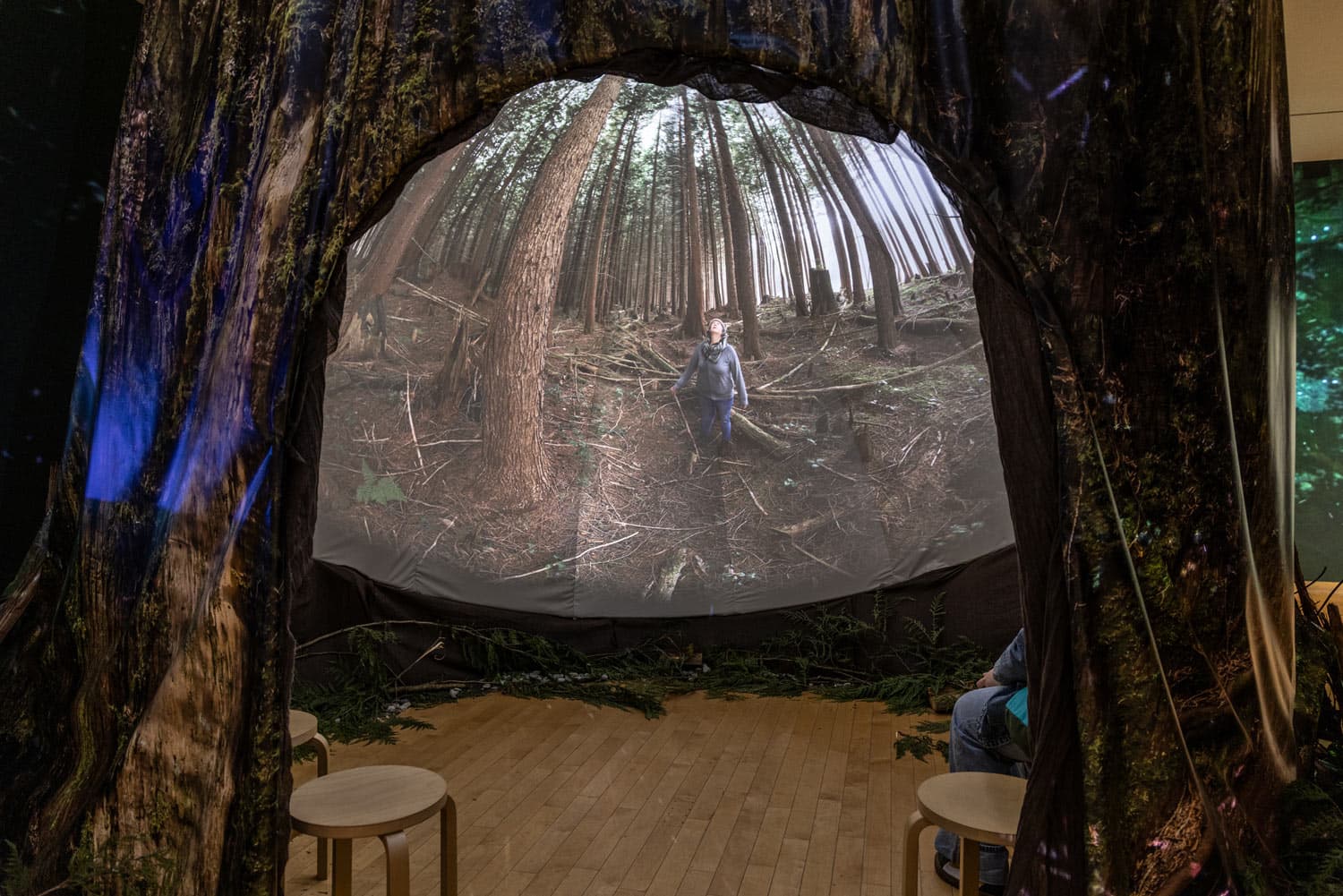
Co-creator Tʼuyʼtʼtanat Cease Wyss is shown standing in a forest as part of the installation SANCTUARY.
Inside the dome, the city disappears. At roughly 3.5 metres across, the dome inside a tree-like structure is large enough for a small group of visitors to sit on stools (or stand) inside together. The walls curve overhead like a forest canopy seen from below, with projected branches, bark, and light shifting across their surface. In the video, one of the work’s creators, Tʼuyʼtʼtanat Cease Wyss, sings in Sḵwx̱wú7mesh and beats a drum. For a moment, the Vancouver Art Gallery seems to loosen around you. The room becomes a threshold between downtown and the deep forest, between image and memory, between what is here and what may soon be gone.
To reach SANCTUARY: The Ancient Forest Experience, visitors pass through an opening draped with cedar boughs, the branches hanging down like the edge of a forest canopy. It is the first sign that the gallery space is giving way to the immersive world inside. They then move through a gallery room of cedar works displayed in vitrines and garments shown on mannequins before reaching the dome. For Wyss, an ethnobotanist, land-based artist, and member of the Squamish Nation, that passage holds deep meaning. In many Indigenous communities on the coast, she explained, cedar entranceways are used for events and ceremonies, helping people leave heavy things behind and clear their minds before moving into a new space.
Created by Wyss, documentary filmmaker Damien Gillis, and film and virtual reality producer Olivier Leroux, the immersive installation is part of Future Geographies, the Vancouver Art Gallery’s new climate-focused exhibition. The installation uses projection, sound, and the scale of ancient growth to bring visitors closer to ecosystems many would never otherwise encounter. The installation poses the question: can an artistic encounter with an ancient forest move people to protect the real one?

When I asked Wyss about her first memory of being in an ancient forest, she described looking down at the roots of a 2,000-year-old cedar and finding a five-year-old one growing there.
“For Indigenous people, we see the plants as our kin, as our family,” Wyss said. “To see a child and an elder together like that in the forest, it just grabs you.”
Wyss experiences time in an ancient forest as alive and layered, visible in yellow cedar, blueberry shrubs, moss, and other life growing together over generations.
“It’s timeless,” she said. “It’s special, and it’s something that we should see in more places.”
That way of seeing runs through her practice, which is shaped by more than 30 years of ethnobotany, storytelling, community teaching, media art, and the restoration of Indigenous ecosystems and natural spaces. In x̱aw̓s shew̓áy̓ New Growth, her 221A Fellowship project, Wyss helped transform an urban site in Vancouver into a communal garden of plants indigenous to the Pacific Northwest Coast.
“Everybody deserves to see these ancient forests,” Wyss continues. Most people, though, will never reach the places SANCTUARY draws from. The terrain is remote, steep, and difficult to access. To create the installation, the team had to carry equipment into challenging forest environments, hauling cameras and gear on rough paths and steep slopes.
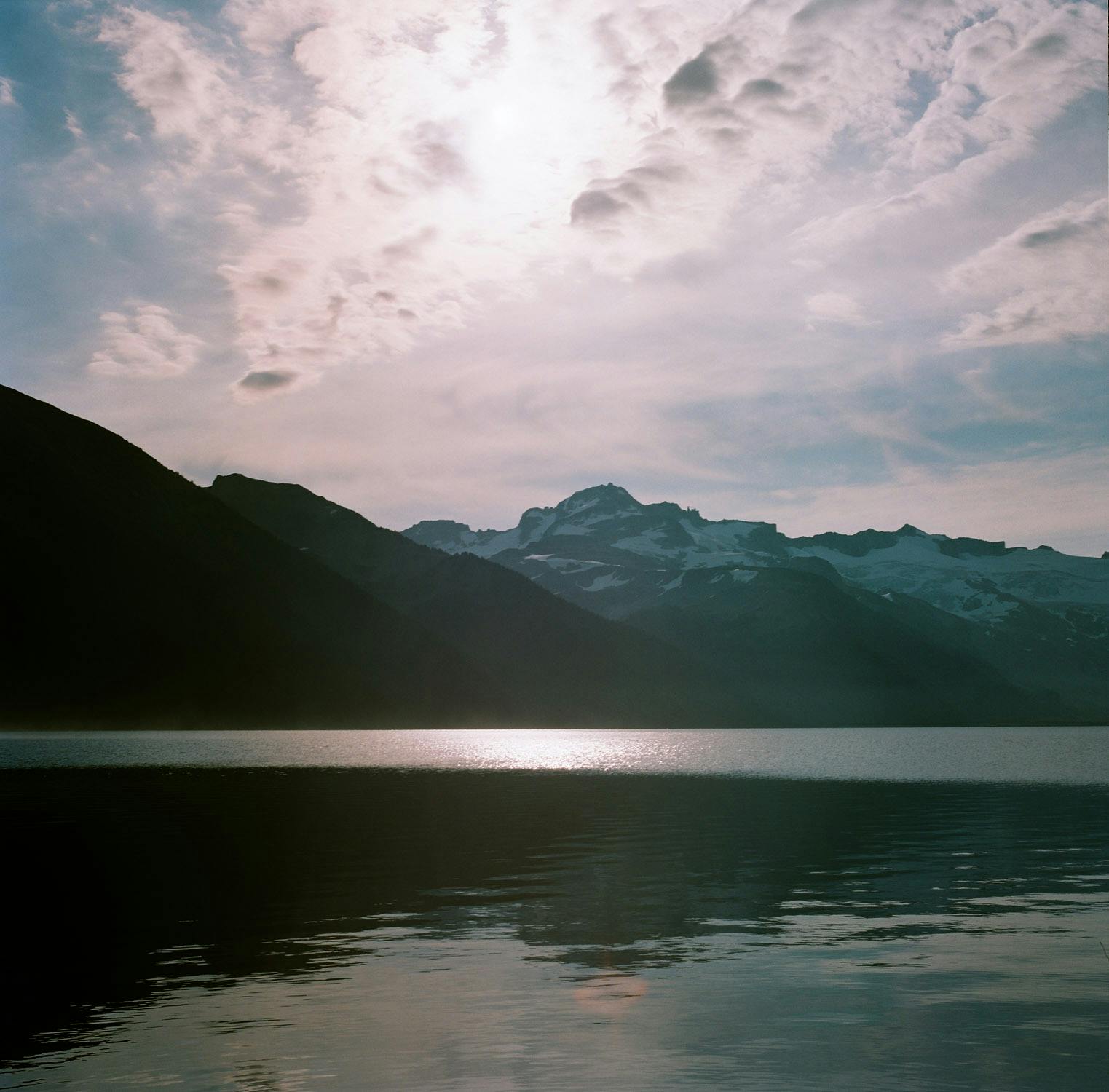
The project began with a forest under threat: Stalkaya—which means “Home of the Sea Wolves” and is known in English as the Dakota Bear Sanctuary—north of Mt. Elphinstone on B.C.’s Sunshine Coast. When Gillis learned it was at risk of being logged, he reached out to Leroux and Wyss. Gillis and Leroux had met years earlier through an Emily Carr University immersive media project, and Wyss had met them through cultural events and conversations.
“It was really kind of an emergency,” Gillis said. He had spent years making films and media projects about wild places, and this forest called for another kind of response. “I thought, let’s put together a project, something unique that’s going to grab people’s attention and maybe reach their hearts.”
The project’s first public version, SANCTUARY: The Dakota Bear Ancient Forest Experience, was presented at the PuSh International Performing Arts Festival in 2021 as an immersive geodesic dome installation focused on Stalkaya. Later iterations brought the work to other sites—including the Museum of Anthropology at UBC—before the team expanded it to include BC’s Inland Temperate Rainforest in the Kootenay region, another old-growth ecosystem Gillis describes as “little known but very significant,” adding that it “doesn’t get a lot of attention or a lot of protection.” For the Vancouver Art Gallery presentation, the installation grew again, with a reusable dome placed inside the form of an ancient tree.
In the Kootenays, they scanned a massive tree using LiDAR, a laser-mapping technology that creates 3D models of objects and landscapes. Wyss described the process as especially difficult in a forest environment, where nothing is flat or easy to move around. Gillis estimated that the tree they worked from may be around 1,800 years old, with a circumference of about 12 metres, making it nearly four metres wide. Gillis described photographing the bark in sections, vertically and around the trunk, so the surface could later be reconstructed. Leroux then stitched the images into an enormous file, which was printed onto canvas and used to create the “tree” surrounding the dome.
For Leroux, the forest needed to be something people could encounter together. Although the installation draws on virtual reality technology, it moves away from one of VR’s most recognizable tools: the headset. After more than a decade working in virtual reality, Leroux understood how easily the headset could become a barrier, isolating people from one another, sitting uncomfortably on the face, or making the experience less accessible. He wanted a different kind of immersion.
“I want to be able to see the work with other people,” Leroux said. “I want to be transported.”
My whole life walking in the forest, I never realized that the forest that I was walking in was regrowth, not old growth.
The project also changed his understanding of forests. His first time entering Stalkaya was also his first time in true old-growth. The experience moved him and frustrated him.
“My whole life walking in the forest,” he said, “I never realized that the forest that I was walking in was regrowth, not old growth.”
Like many people in Vancouver, he had walked through Stanley Park assuming he was moving through something ancient. Later, he learned that much of the park had been logged more than a century ago. Ancient forests were not as close, common, or accessible as he had imagined.
“Most people, including my kids, will probably never walk into an old-growth forest,” Leroux said.
In a city like Vancouver, nature can feel omnipresent. Mountains rise in the distance, the ocean swells nearby, and green space threads through daily life. But proximity to nature can blur an important distinction: a green space is not the same as a forest, ancient or otherwise. A replanted landscape does not carry the ecological memory of a cedar that has been growing for two millennia.
The cedar in SANCTUARY brings that difference back into the body. For Wyss, the work is “all about cedar.” To enter an interactive dome without being able to touch or feel cedar nearby would have made the experience feel distant. The archway reminds visitors that the installation is cultural and alive with ongoing practice.
“This isn’t just from 500 years ago,” Wyss said. “It’s from five minutes ago… Every day, Indigenous people on the coast are gathering cedar and using it.”
Wyss also spoke about her late mother, who had always wanted to visit the ancient forests but became unable to make the journey as she grew older. Before she died, the team was able to show her an earlier version of the project. For Wyss’s mother, the experience carried the forest across a distance her body could no longer travel.
“She loved it,” Wyss said. “She was like, ‘I never imagined being able to go to that place. And how far up it was and how hard it is to get there.’”
That ability to bring distant places closer is also what gives the project its political force. For Gillis, media has always been tied to action. He has spent much of his career making work designed to help protect wild salmon habitats, ancient forests, farmland, and other threatened landscapes.
“I make media designed to protect places,” he said, “and a lot of times it actually does work.”
Gillis sees storytelling as a way to move people from awareness into action. He believes media can help people understand what is at stake, become emotionally invested, and feel called to respond.
“Sometimes it really requires good storytelling in media to get people aware of the issues and get them fired up about it,” he said.
The pressure on forests like the ones represented in SANCTUARY has not eased. Gillis described an industry pushing to access the last remaining areas of valuable timber, including places many people might assume are protected.
This isn’t just from 500 years ago. It’s from five minutes ago. Every day, Indigenous people on the coast are gathering cedar and using it.
The installation is beautiful and unsettling in equal measure. It draws viewers into awe while keeping the forest’s vulnerability close, reminding us that while technology can bring the forest into view, what threatens it remains outside the dome. Wyss sees that transportive quality as part of the work’s purpose. Media art, she said, can bring people closer to places they may never be able to visit firsthand. It can raise awareness, make people think, and open a path toward change.
“We need to think about our actions,” she said. “For a century, many people didn’t care about their actions, and now we have only a handful of places left to save.”
Inside the dome, visitors sit within the image of an ancient tree. Outside it, they pass again through cedar. Somewhere beyond the gallery, in a forest most of them may never reach, a five-year-old cedar sprouts at the roots of a 2,000-year-old one.
Elder and child, still growing.
Future Geographies: Art in the Century of Climate Change runs at the Vancouver Art Gallery until January 10, 2027. SANCTUARY will be on display through November 15, 2026.
This story was first published on The Green House, our membership platform. Join us there for early access, discounts and freebies, community discussions, and to support our work telling the large and small stories of how we can live sustainably.