BC Seniors Boost Their Climate Lobbying Skills
Seniors for Climate is helping elderly Canadians have impactful conversations with their elected representatives.

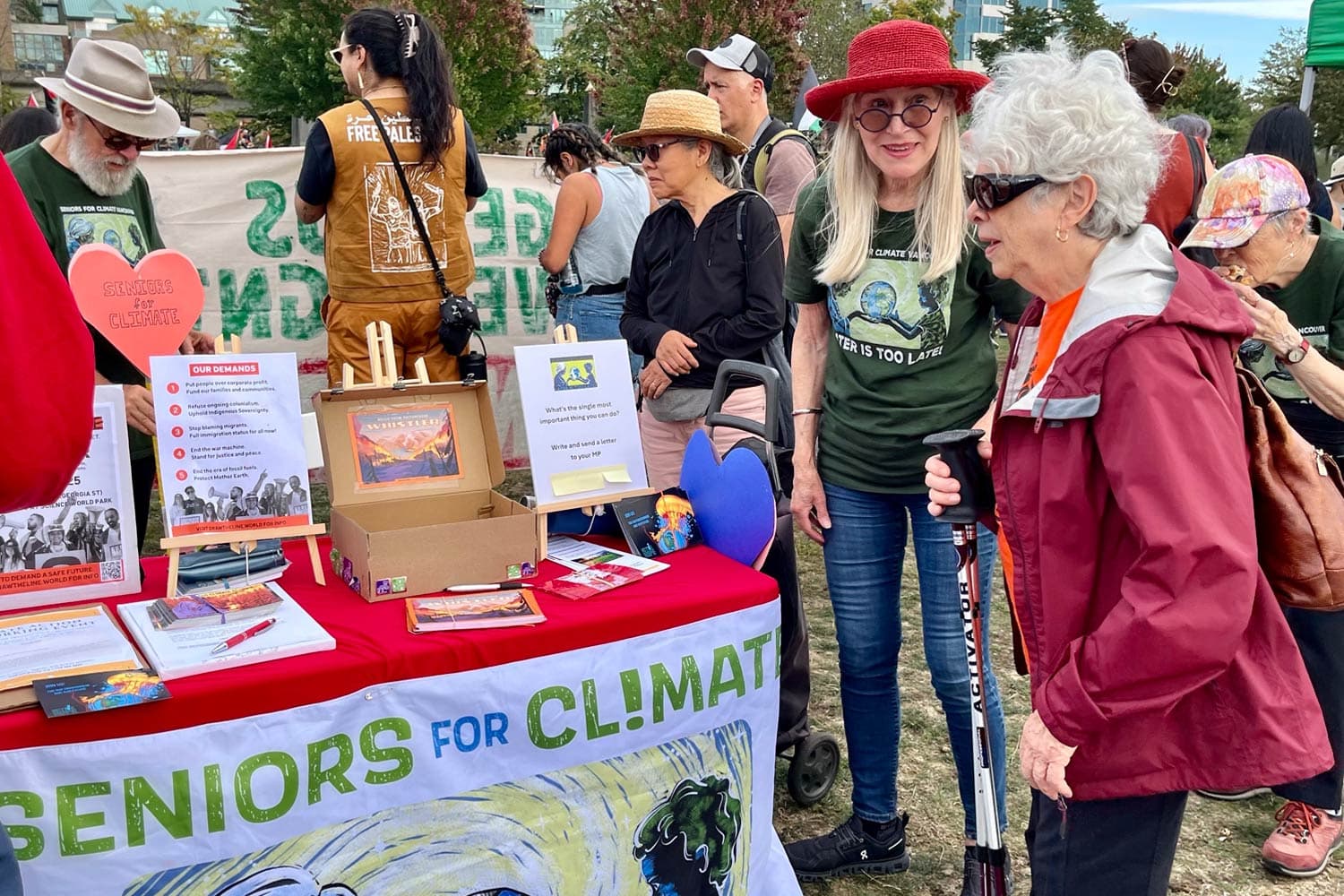
Seniors for Climate hosted an information table at Vancouver’s Draw the Line protest on September 20, 2025.
Workshop participants at East Vancouver’s 411 Seniors Centre sat in groups of four to six around copies of the BC Climate Emergency Campaign’s 2025 Progress Report. On the report’s cover, a flare stack burns against the night sky above Kitimat, BC. Inside, the report gives the provincial government failing grades on eight of ten urgent climate actions, its worst performance since the campaign began issuing progress reports in 2022.
Organized by Seniors for Climate’s BC hub, the BC Climate Emergency Campaign, and Possible By Design (a nonprofit that translates climate science into practical guidance), the June 5 event was designed to help seniors talk about climate change with family, friends, neighbours, city councillors, MLAs, and MPs. By the end of the workshop—titled Break Through the Climate Silence—the 50 participants had practiced using a combination of personal experience and research to have meaningful climate policy conversations with the people elected to represent them.

Mari Piggot, who works on campaign strategy and engagement with the BC Climate Emergency Campaign, walked participants through the report’s findings with the conviction of someone who had repeated the same urgent truths in too many rooms. In 2023, BC’s emissions were 18% above 1990 levels, she told participants. The report warned that pollution from approved liquified natural gas (LNG) projects could cancel out climate action in every other sector.
Then she shared the 2025 report’s grades. Setting binding pollution targets based on science and justice: fail. Investing in a thriving, regenerative, zero-emissions economy: fail. Rapidly winding down fossil-fuel production and use: fail
The BC government, she explained, likes to describe the province as a climate leader. The report suggested otherwise. The government’s own climate accountability reporting has said BC is not on track to meet 2030 emissions targets, and the progress report argued that the gap between ambition and action is still too wide. On June 30, 2025, LNG Canada loaded its first export cargo in Kitimat, marking the start of operations at Canada’s first large-scale LNG export facility. For Piggot, the timing made the report’s warning feel less abstract.
After this introduction, she set the report aside. It had established the problem. The next question was what to do about it. If participants were going to bring its findings into the offices of their MLAs, they needed more than numbers. They needed a way to make the numbers personal.
“Personal storytelling is extremely powerful,” she told the room. An MLA might forget a statistic, she said, but they were less likely to forget a constituent talking about what climate change had already taken from them or the people they were trying to protect.
She asked everyone to turn to the person beside them. Think about what keeps you awake at night, she said. What has changed? Who do you want to protect?
An MLA might forget a statistic, but they were less likely to forget a constituent’s story.
Piggot invited participants to think about how climate change had touched their lives, even if they did not feel they had experienced “the worst of it.” In BC, she said, people were already living with the impacts of a changing climate, from atmospheric rivers and landslides to wildfire smoke, extreme heat, and deadly storms. Even avian flu, she suggested, belongs in a wider story of ecological disruption, where changing temperatures and migration patterns can affect how disease moves through wild bird populations.
In my group, I went first. Growing up in Nigeria, I saw butterflies everywhere. They drifted through gardens and empty lots and settled on flowers without anyone paying much attention to them. But I can’t remember the last time I saw one.
The woman beside me had already tried turning that kind of concern into political action. About a year earlier, she had spoken directly with members of the provincial Conservative caucus about climate policy. She came away with the sense that, while party positions limited what some MLAs would say publicly, individual members were still willing to talk.
The key, she said, was finding shared values. She had managed a real conversation with the MLA for Delta South by talking about pollinators. The MLA works with farmers, and farmers need bees. Climate change, she told him, was adding pressure to pollinators already affected by habitat loss, pesticides, disease, and shifting seasons.
The exchange showed what the exercise was trying to achieve. The Seniors for Climate workshop was built around moving the progress report off the page and into policy. Its findings were meant to become personal stories, phone calls, follow-up emails, and pressure on elected officials. Facts alone, Piggot argued, were not enough. Elected officials also needed to hear directly from constituents about why climate action mattered to them.
MLAs vote on provincial laws, answer to constituents in their ridings, and can carry local concerns back into caucus and the legislature. Piggot said elected officials kept telling advocates they were no longer hearing from constituents about climate concerns. So the first step she said participants should take was deceptively simple: tell an MLA, “I care about climate.”
“You don’t need to be an expert,” she told the room.
Much of the discussion returned to LNG, which Piggot described as one of the biggest threats to BC’s climate commitments. She walked participants through the life cycle of this fossil fuel, from fracking and extraction to processing, transport, export, and eventual combustion. The point, she said, was that LNG’s climate impact does not begin or end when the gas is burned. Methane, a potent greenhouse gas, can leak at multiple stages, including during extraction, processing, and transport. Fracking uses large volumes of fresh water. Communities near extraction sites have raised concerns about health and environmental impacts.
Industry representatives and government officials who support LNG often describe it as cleaner than coal and as a transition fuel that could help countries move away from higher-emitting fossil fuels. They have also claimed that BC could produce some of the cleanest LNG in the world because facilities can use hydroelectricity to power parts of the liquefaction process. Piggot pushed back. Comparisons to coal often focus on emissions from combustion, she said, while overlooking emissions from extraction, processing, transportation and methane leakage across the LNG supply chain. She argued that electrifying parts of the liquefaction process does not eliminate those other sources of emissions.
“Natural gas is not ‘green,’” she said. “It’s not clean. “That’s a greenwashing tactic.”
Participants were also given responses to common talking points they might hear from elected officials. One was the argument that LNG is necessary for jobs and economic growth.
Piggot pointed to the proposed Ksi Lisims LNG project, whose initial capital cost is estimated at C$9.9 billion and which project filings suggest would directly employ about 150 to 350 permanent workers in BC. Piggot compared that workforce to the staff of a high school and argued that investment on that scale could support far more green jobs. For her, the contrast undercut claims that LNG expansion would deliver broad, lasting employment.
If industry lobbyists could keep showing up to influence the government, ordinary citizens could make one visit to their own elected representative. And then another.
Then she widened the frame. Wildfires, floods, and extreme heat are already imposing major costs on BC residents, Piggot said. Communities are having to rebuild after disasters with increasing frequency. According to a 2024 Statistics Canada report, catastrophic weather claims have cost Canadian insurers hundreds of millions of dollars a year from 1983 to 2008. Since 2009, that annual average has risen to almost C$2 billion. Those losses also contribute to rising insurance costs. All of those climate costs, Piggot argued, belonged in the conversation alongside LNG jobs.
She pointed to eastern Australia as evidence that LNG exports can add to household costs. After export terminals opened in Queensland in 2015, domestic wholesale gas prices became linked to international LNG prices, according to the Reserve Bank of Australia. The bank found that east coast wholesale prices rose sharply around 2015 and subsequently averaged roughly twice their level during the first half of the decade.
A 2025 analysis from the Institute for Energy Economics and Financial Analysis said domestic gas prices had tripled in the decade since Queensland began exporting LNG, increasing costs for local consumers and contributing to the closure of some manufacturing operations—in other words, lost jobs. For Piggot, Australia complicated the promises of jobs and public revenue used to promote LNG development in BC. Residents could also face higher energy costs, she argued, alongside the growing financial toll of climate disasters.
At this point, a participant pulled out her phone and began reading aloud from Environmental Defence’s Federal Oil & Gas Lobby Bot. Created by the Canadian environmental advocacy organization, the automated feed draws from Canada’s federal lobbying registry and posts recent communications between oil and gas representatives and federal officials. She told the room that oil and gas lobbyists had 553 meetings with federal officials between January and April 2026.
That number raised the stakes of the workshop. Participants were learning how to get ordinary people into rooms with elected officials, while oil and gas lobbyists were already reporting hundreds of communications with them. The imbalance made the need for sustained public pressure feel more urgent.
The lobbying records were federal, and though the workshop was focused on provincial MLAs, the lesson was about access. If industry lobbyists could keep showing up to influence the government, ordinary citizens could make one visit to their own elected representative. And then another.
The advice was practical and procedural. Reach out when the legislature is not in session and MLAs are more likely to be in their constituency offices. Get to know your MLA’s staff, not just the elected official. Drop off the report far enough in advance that someone might read it before you arrive. Bring two to four people, no more, and designate someone to watch the time so the group can cover its main points and still leave space for the MLA to respond. Begin with gratitude. Look for shared values.
The goal, participants heard, was to build a relationship that could survive more than one meeting. One advocate, Piggot recalled, emailed his MLA every day until he secured a meeting.
“I think a lot of us are worried about being too persistent or too annoying,” she said. “My past experience is that persistence works. Really.”
She also reminded participants that MLAs are elected to represent them. Constituents are not asking for a favour by requesting a meeting. They were using a basic democratic tool.
Elected officials weigh different forms of public pressure differently, she said. Emails and phone calls matter, but in-person meetings carry particular weight. To an MLA, she suggested, a constituent asking to sit down face to face can signal commitment and the ability to organize others.
Erlene Woollard, one of the workshop’s organizers, had already put this advice into practice. She said she had met twice with her MLA, Niki Sharma of Vancouver-Hastings, and was now working with the MLA’s office on the early stages of what she called a “community climate action team”: a group of constituents who would meet with the MLA and staff over time to discuss climate concerns and follow up on possible action.
Constituents are not asking for a favour by requesting a meeting.
At one point, the discussion turned to issues of particular relevance to seniors. Participants questioned why retirement funds, including the Canada Pension Plan, remain invested in fossil fuels, while acknowledging that seniors depended on those pensions and could not simply walk away from them. Piggot encouraged participants to speak with their MLAs about the provincial policies within their control, including LNG expansion and climate preparedness. She also pointed out that seniors are especially vulnerable to climate impacts such as extreme heat, recalling the disproportionate toll of BC’s 2021 heat dome on older people. She encouraged participants to share their own experiences as seniors, including concerns about pensions and climate vulnerability, when meeting with their MLAs.
After the workshop ended, I spoke with Hilde Colenbrander, one of the event’s organizers, who has lived in Vancouver since moving from South Africa in the 1980s. She told me about Active Hope, an approach developed by the late eco-philosopher and activist Joanna Macy and physician and resilience educator Chris Johnstone. In their book of the same name, they describe a three-part practice: facing reality as it is, identifying the future you hope to help create, and taking steps toward it.
The workshop’s participants were already practicing that kind of hope. Around me, people were exchanging contact information, comparing notes, and talking about who they would contact next. The workshop had begun with a question about what kept them awake at night. It ended with a list of things to do in the morning.
Seniors for Climate’s BC hub is planning more events for fall. People interested in future events can contact the group at bc-hub@seniorsforclimate.org.
This story was first published on The Green House, our membership platform. Join us there for early access, discounts and freebies, community discussions, and to support our work telling the large and small stories of how we can live sustainably.