Eco-horror Play Buzzes with Music and Morality
The Apiary takes Vancouver audiences to a near-future where saving bees risks researchers’ humanity

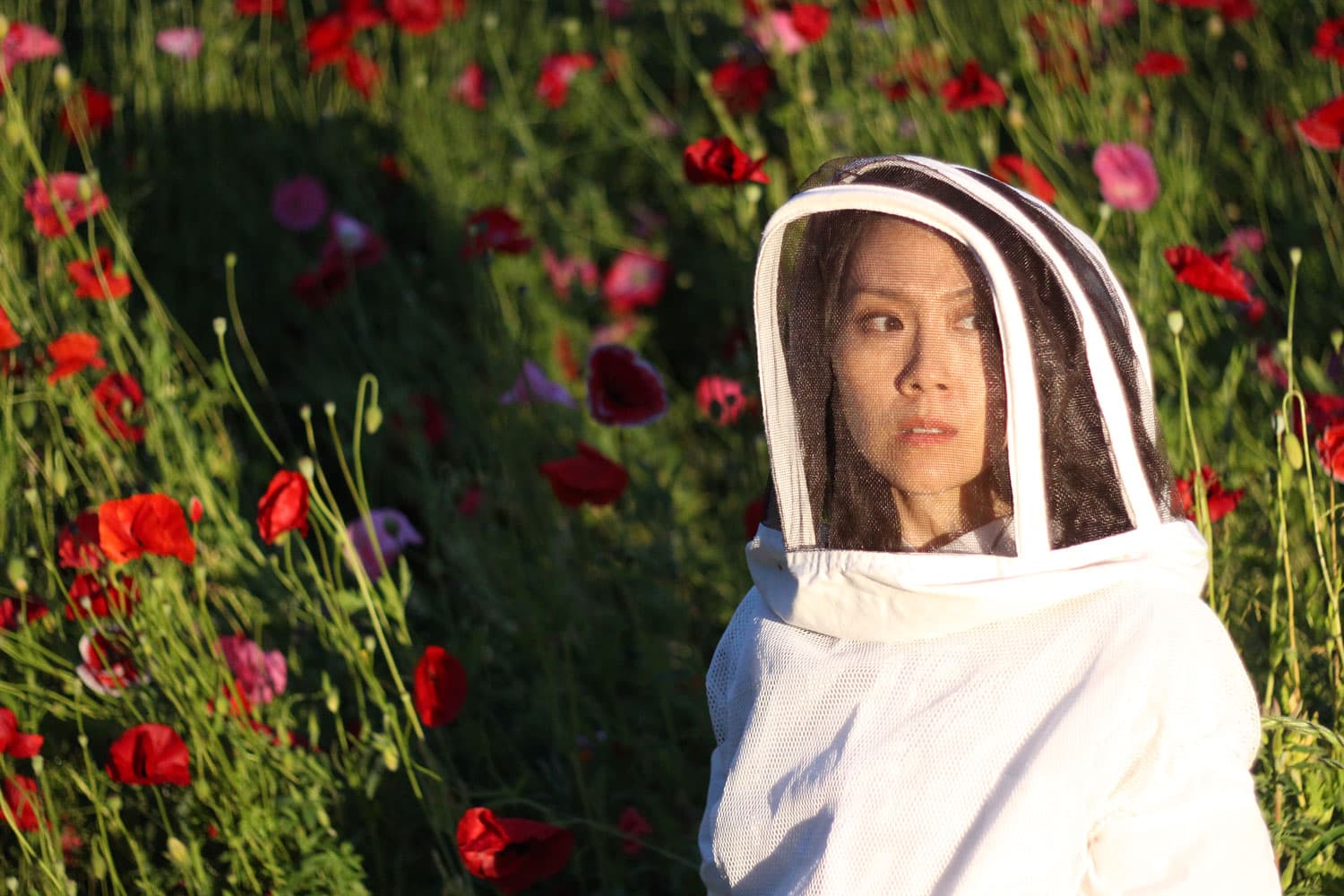
Jasmine Chen stars in The Apiary.
How far would you stretch your morals to save a life? A species? The world?
A group of acclaimed Vancouver theatre artists are pondering these questions in their upcoming production of New York-based playwright Kate Douglas’s The Apiary. It’s a dark, funny play about a near-future where bees are almost extinct, and all life, including humans, is increasingly ill.
The group behind the show is called the Apiary Collective, which includes actor Jasmine Chen (who plays Zora) and director Daniela Atiencia. The collective assembled last year, says Chen, at the instigation of Christine Quintana, who plays Pilar in the production. (Quintana also serves on the board of the Asparagus Journalism Society, which publishes Asparagus.) Chen and Atiencia joined me on Zoom two weeks before the show’s opening to talk about collaboration, moral ambiguity, climate grief, and what it was like to explore a jarringly relatable dystopia.

“I appreciate that it’s not what we think of in terms of typical dystopia,” Chen says about what stood out to her most about the play. “The way the characters speak, they sound like us. Kate sets the play 22 years in the future, which is not that far away.”
That closeness in time and familiarity of character helped make things feel real and urgent for Chen. “They talk about, ‘Oh, remember when everyone used to drink almond milk like it was nothing?’” she says. “That’s the age we’re living in now.”
For Atiencia, the moral dilemmas faced by the characters were what struck a chord. “I love questions like, ‘How far would you push your values to save something that’s really important to you?’” she says.
The eco-horror story follows Zora and Pilar, two research assistants at a decrepit lab who discover a morally questionable method that causes a boom in their captive bee population. They hide their methods from their promotion-seeking supervisor Gwen, who risks endangering the bees further by slowing the scientists’ work with institutional roadblocks.
“We really liked how these women get to be brilliant and flawed and funny, and also competitive, which makes it complicated,” Atiencia says. “The play is written for women, and that allows it to explore questions of power, ambition, but also collaboration and care through relationships that wouldn’t often be centered on stage.”
How do we continue to be human to one another when the world is falling apart?
Douglas’s focus on how women relate to one another and navigate ethical and moral quandaries is a sort of funhouse mirror reflection of the joy Atiencia and Chen felt collaborating with the rest of the team. Some collective members had worked together previously, though never in this specific combination. On the page, Zora and Pilar take the matter of saving the bees into their own hands. In real life, the play was a chance for everyone involved to “choose each other,” Atiencia says.
“So often, we’re waiting for grant funding, or we’re trying to get programmed by different institutions,” Chen adds. “We didn’t want to wait for permission.”
Opposite Zora and Pilar are the bees themselves, who are listed as characters in the script. In one past staging of The Apiary, fake bees filled a set enclosed by netting. In another, the bees were “buzzing” stage lights. In this production, the bees come alive through digitally looped and layered violin played live by Molly MacKinnon.
Chen recalls that Quintana showed the script to MacKinnon before sharing it with others: “Both of them got really excited by the concept of Molly being the bees.”
“For theatre makers, it’s always a gift to have a musician in the room who can riff live, devise, and collaborate,” says Atiencia. “And Molly has such a gift.”
How far would you push your values to save something that’s really important to you?
The script calls for the bees to be constantly present and “go on their own journey,” Chen says. This is a challenge that each production tackles uniquely. For the Apiary Collective, “it felt more appropriate that she was… in the room with us and responding to what we’re doing, because so much of this play is about the relationship between human beings and the bees,” Atiencia says.
Chen points out that the script includes “very detailed descriptions of how we should be hearing them and what’s happening to them.”
“We are following the stage directions as best we can,” Atiencia adds, chuckling. “The play fluctuates between human time and ‘bee time.’ We freeze human time, and we let the bees… do their thing.”
For Chen, the play is a word of caution about what we risk losing. “We talk about climate anxiety, but we don’t always talk about climate grief, and recognizing the things that are at stake,” she says.
The Apiary prompts audiences to zoom out and examine how connected humans are to the larger web of life. “How do we stay connected amongst anxieties?” asks Atiencia. “How do we continue to be human to one another when the world is falling apart?”
Correction: This story originally contained a misspelling of Daniela Atiencia’s last name.
The Apiary runs July 16–25 at the Vines Den. Most shows run from 7:30 p.m. to 9 p.m., except July 18, which runs 2 p.m. to 3:30 p.m. Tickets are available online.
This story was first published on The Green House, our membership platform. Join us there for early access, discounts and freebies, community discussions, and to support our work telling the large and small stories of how we can live sustainably.