Soma Makes Good Chocolate Choices
After 22 years, Canadian bean-to-bar pioneers continue to mix sustainability into every treat.

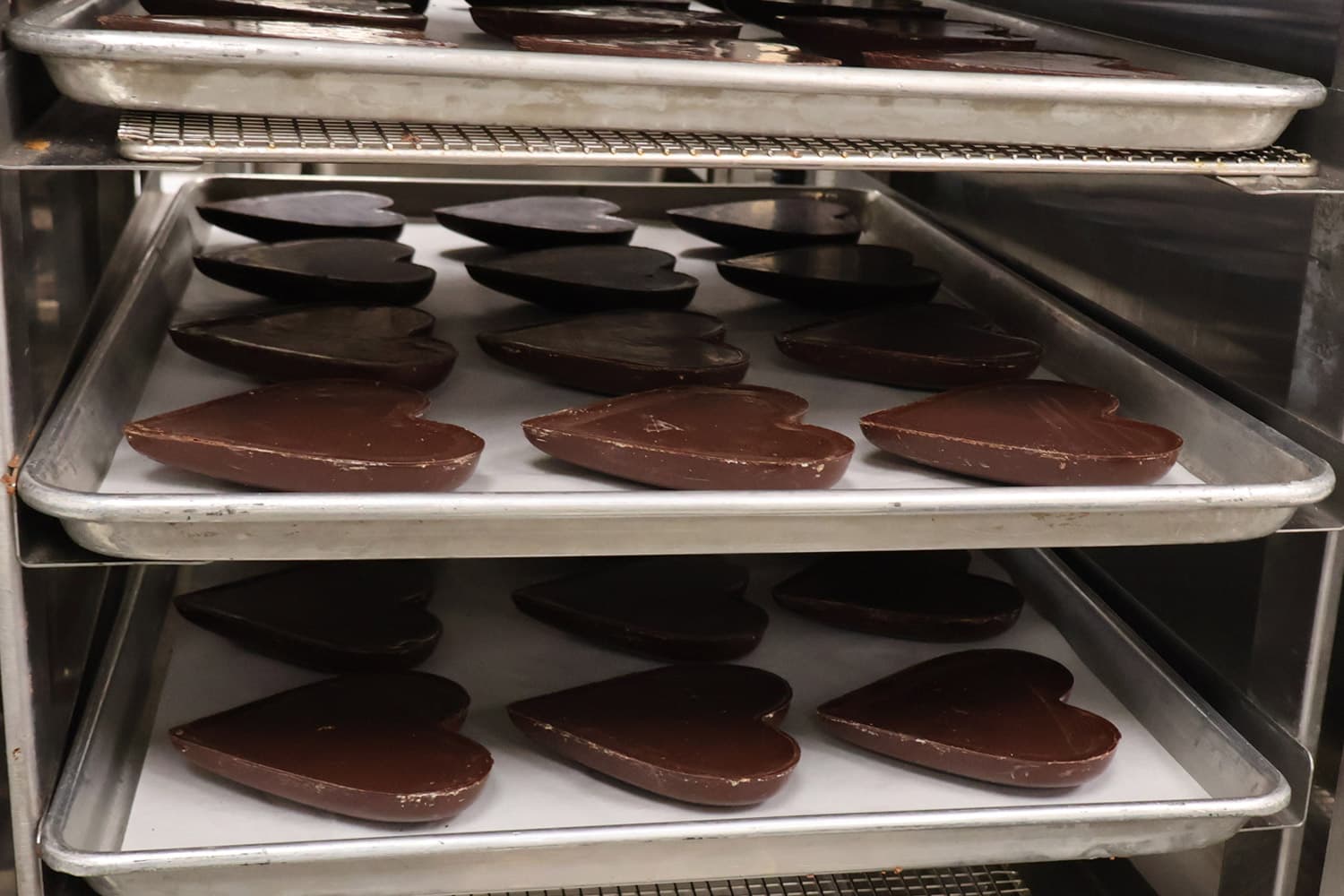
Chocolate hearts await packaging on racks in Soma’s Parkdale factory in Toronto.
The Brock Avenue factory of Soma chocolatemaker in Toronto’s Parkdale neighbourhood stimulates all the senses. Machines grinding cocoa beans roar behind large windows. Mass timber ceilings give the space a visual warmth matched by the team of friendly uniformed employees putting finishing touches on Valentine’s Day treats. A strong aroma of cocoa lingers in the air, and a bite of the dark chocolate Mr. Salazar bar evokes its Ecuadorian roots with sweetness cut by a slightly bitter tang.
The space was designed by co-owner Cynthia Leung, a former architect who opened the first Soma location in 2003 with her husband, pastry chef David Castellan. The small shop-slash-factory in a former whisky distillery—in Toronto’s eponymous Distillery District—was one of Canada’s first bean-to-bar chocolate producers.

The term “bean to bar” describes chocolate-makers who conduct the entirety of the manufacturing process themselves—everything from sourcing unprocessed cocoa beans to putting the packaged product on the shelf. Bean-to-bar producers are often leaders in sustainable and ethical chocolate-production practices, which is certainly true of Soma.
This matters, because the worldwide chocolate industry (valued at over US$120 billion) has been found to cause real ecological and social harm. A recent report by Global Witness, a British non-profit dedicated to exposing links between environmental and human rights abuses, found that some of the world’s largest chocolate conglomerates—including Mars Group and Hershey’s—purchased cocoa whose production contributed to the deforestation of large areas of Liberia. The report states that between 2021 and 2024, an area of forest larger than 250,000 hectares (about 4% of the country’s forest) was cleared for cocoa farming. Monoculture cocoa farming also leads to soil degradation and water source pollution resulting from pesticide and fertilizer use.
Not only does cocoa farming cause environmental harm, but the United Nations Development Programme (UNDP) reports that deforestation and unstable weather caused by global warming pose serious threats to future cocoa bean production. Top exporting countries Ghana and Côte d’Ivoire, which together produce about 60% of the world’s cocoa, could become unsuitable for growing the crop in a matter of decades.
Human rights violations are also common in the industry. In 2025, the US Department of Labor estimated that in Côte d’Ivoire and Ghana alone, 1.56 million children were involved in child labour on cocoa farms. The problem isn’t restricted to Africa; in Brazil, commodity trader Cargill was fined US$120,000 in 2023 for buying cocoa from farms employing child labour.

The company’s third location includes a shop area with windows through to the factory itself.
Aware of these abuses, Soma’s owners take a hands-on approach to their network of suppliers, which includes cocoa farmers in 17 countries on three continents—including Vietnam, Venezuela, and Madagascar.
“We’ve avoided areas that have problematic histories,” said Castellan during the factory tour he and Leung gave me. “West Africa was difficult, but we did find some [cocoa beans] from Ghana in the beginning that were ethically sourced. But we haven’t used it for a long long time.”
Of the suppliers they currently work with, Castellan said, “We call them up on the phone. We visit them.” These relationships allow Soma to offer deep transparency about their products. For instance, the cocoa that goes into their Semuliki Forest bar is produced by almost 600 smallholder farmers in Uganda’s Bundibugyo district. The bar’s packaging has a QR code that takes customers to a PDF listing every farmer, how much cocoa they sold to Soma’s supplier, date of purchase, and price paid.
Sustainability has also been a guiding principle for Soma’s founders, from their humble beginnings to today’s larger operation of three Toronto locations and retailers on three continents. To avoid the aforementioned harms from pesticides and fertilizers, they work with many certified organic cocoa suppliers and also use organic sugar.
“Since chocolate has more or less three ingredients,” said Castellan, “it’s more or less organic.” He noted that cost has been the major barrier to Soma pursuing its own organic certification.
The cocoa that goes into Soma’s Semuliki Forest bar is produced by almost 600 smallholder farmers in Uganda.
Additional sustainability steps include buying gelato flavourings like raspberries and strawberries from local farmers and making packaging from eco-friendly paper instead of plastic when possible.
“It’s always on our minds to be as sustainable as we possibly can be,” said Leung. “I wish there were better solutions, but the industry has really not caught up to what we want in our packaging.”
She also makes sure that colleagues in the industry know about sustainable options when they encounter them, like spreading the word when Soma’s packaging printer offered a sustainable paper option. “If that in any way is … making a little change within the paper industry,” said Leung, “then I’m pretty happy.”
Having a community of small-scale chocolate producers to share these insights with is a big change from their early days. One of the challenges the duo remembers facing was acquiring cocoa beans at a non-industrial scale.
“We would call around, and we would say ‘Could we get two bags?’” Leung recalls. “They would say ‘Do you mean two tonnes?’ And we would say, ‘No, two bags.’ And they would pretty much hang up the phone.”

Above—Cocoa nibs (the flavourful portions of cocoa beans that are removed after roasting) await grinding in Soma’s Parkdale factory. Below—Future treats going through the moulding process.
As pioneers in Canada’s small-batch chocolate industry, they also struggled to find the right machinery. One solution they came up with was repurposing a coffee roaster, and they even assembled some of their own equipment with parts from Home Depot.
The result of their persistence is an array of truffles, cookies, drinking chocolates, gelatos, and award-winning treats like their Pecan Pie Pralines, the six-time International Chocolate Award-winning Guasare dark chocolate bar, and three-time winner, the Mango Lassi Bar.
Yet for the co-owners, the greatest reward is the relationships they’ve formed. “The community of bean-to-bar makers is pretty tight,” said Leung, explaining that if Soma is upgrading their machinery, they’ll pass the old model on to other chocolate-makers they know. “We share machines, we share knowledge. It’s really important to us to do this as a community. When we see each other, they’re like family.”
People are not happy if they come in and we don’t have a good showing from Soma.
Two more community members are Katey Wright and Peter Jorgensen, owners of Origins Chocolate Bar, a “chocolate oasis” (in Jorgensen’s words) in New Westminster, BC. Origins only carries bean-to-bar chocolates. Their product-selection process starts with a deep dive into where producers source their cocoa beans and if they do so ethically. The next step is looking into the chocolate-maker’s code of ethics and value statements, and whether they mention a relationship with their growers.
“We want to know if they have been to the origin country,” said Jorgensen in a phone interview. “What kind of relationships do they actually have with cocoa producing regions?”
Wright and Jorgensen were first introduced to Soma in 2014 by their friend David Mincey, founder of The Chocolate Project in Victoria, BC. Wright’s first taste of Soma’s Old School bar was love at first bite. Since she and Jorgensen opened Origins in 2018, Soma products have always been on the shelf. And if they’re ever short on stock, customers let them hear about it.
“People are not happy if they come in and we don’t have a good showing from Soma,” Wright said. But she points out that they don’t have the opportunity to sell every Soma product. “We don’t actually have access to everything that they make, which I think is outstanding,” she explained. “There’s some things that they just make for their storefronts, for the customers that actually physically walk in the door.”

New Westminster’s “chocolate oasis” has stocked Soma products since opening in 2018.
Success has come in many forms for Soma, including awards, expansion, and growing their chocolate community. Yet for Castellan, pride comes from going strong for over two decades.
“There’s a lot of things that could have gone wrong along the way,” he said. “And I think we’ve been pretty good at making the right decisions over 22 years. That’s a million decisions, if you reflect on it. So on a basic level, you’re proud just to exist.”
In terms of the future, Soma’s goal is to grow without losing the identity that’s brought them this far. “We hope to continue visiting cocoa farms, making and keeping those connections alive, and then also selling internationally,” said Castellan.
“Our goal is to make even better cocoa,” said Leung. “It’s never been to get bigger. We’re interested in making our chocolate even better.”
This story was first published on The Green House, our membership platform. Join us there for early access, discounts and freebies, community discussions, and to support our work telling the large and small stories of how we can live sustainably.