Are You Gardening With Wool Yet?
Everyone’s favourite biodegradable fibre is as good a choice for your veggie bed as it is for your sweater drawer.

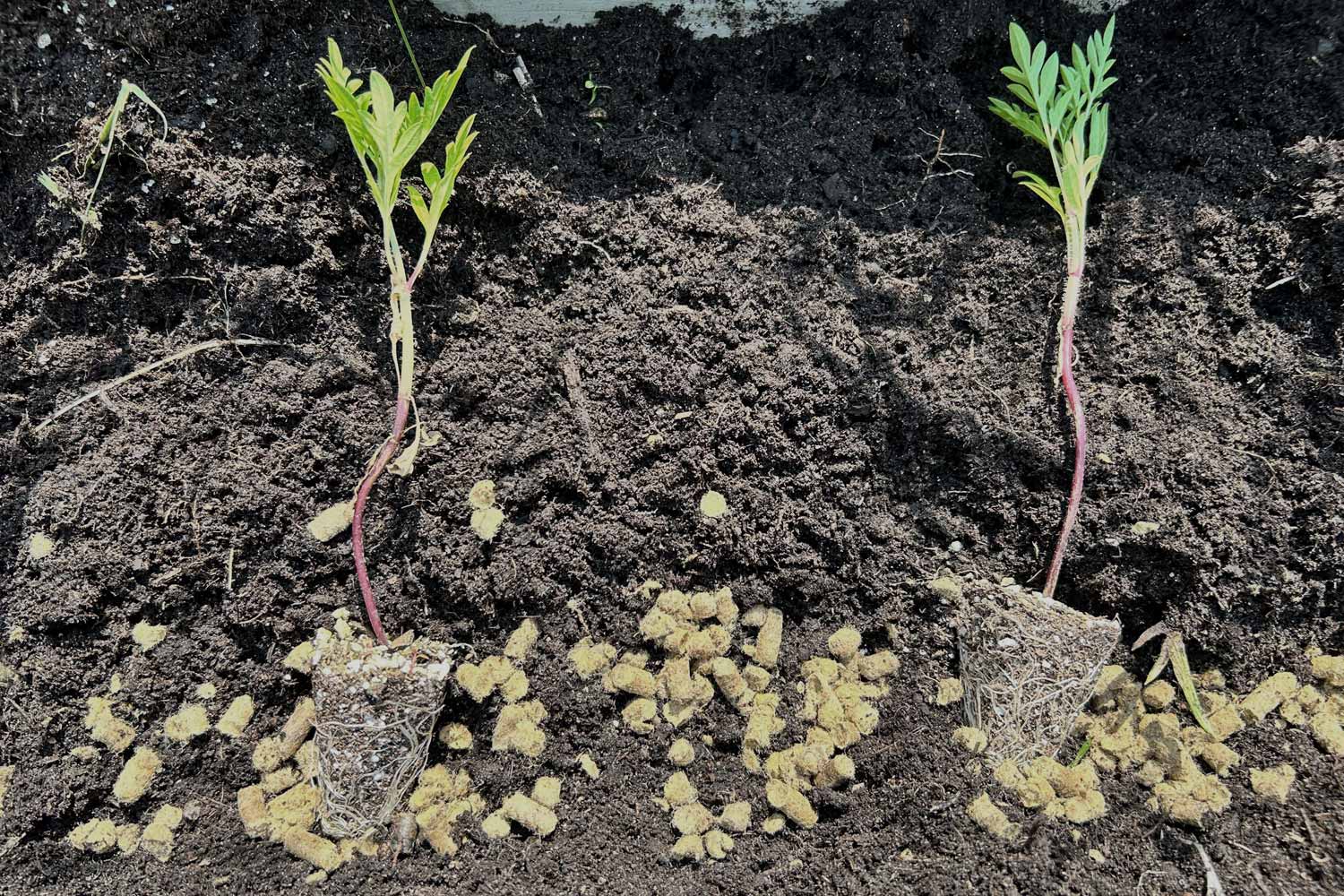
A pair of seedlings await transplant into soil amended with biodegradable wool pellets.
Browse through the 2026 gardening catalogue of retailer Lee Valley, and you’ll find the standard array of accoutrements: self-watering planters, super-sharp secateurs, forks and spades, trellises and tomato cages. But there’s a garden fabric and a soil amendment that might give you pause as you flip through. These items themselves aren’t new or revolutionary, but the material they’re made of kind of is, while at the same time being as old as dirt. Not plastic, not peat, but sheep’s wool—and sometimes Ontario wool at that. Yes, the sheep farmers are coming for a garden bed near you, ready to boost your soil and your plants too.
“Wool is basically a renewable product,” says Anna Hunter, a Manitoba sheep farmer (and onetime Vancouver yarn shop owner) and author of The True Cost of Wool. “Sheep are growing it every year.” Even when those sheep are being raised for meat, which is most of the time in Canada, that wool needs to be shorn annually. But farmers all too often burn, landfill or compost the fleeces to get rid of them, as they fetch such a low price that it doesn’t even cover the cost of shearing—partly due to market factors, partly because the breeds they raise aren’t targeted for textiles, and partly because there’s little motivation to keep the sheep clean enough that the wool is in good-enough condition to be washed, carded and spun. The wool quality is poor enough that prices are low, and prices are so low there’s no incentive for farmers to try and improve quality. In other words, the situation is a bit of a Catch-22.

But it’s also an opportunity, and it’s one Hunter and other farmers are trying to take advantage of. Because even if most of the wool being grown in Canada isn’t considered soft and fine enough to spin and knit into a luscious sweater, it still has lots of potential benefits to the land—and to the producers’ bottom lines. Wool “really benefits the health of our plants and the health of our soil,” Hunter says. “It adds aeration, it adds nitrogen and other nutrients, it increases water-holding capacity.” On top of that, she notes, it’s more sustainable—especially as a waste product that already exists—than other water-retaining soil amendments like peat and coconut coir. “We’re actually adding value to something that is being wasted within the agricultural industry.”
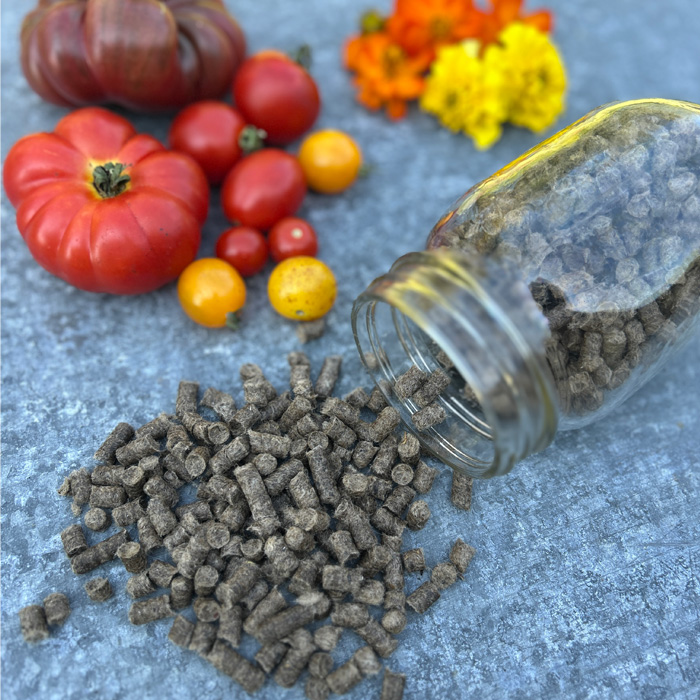
One of the more common wool products you might find in your local garden store, as well as in the Lee Valley catalogue, is wool pellets: squishy, grey-brownish chunks of wool about the size and shape of a haskap berry that you can mix into soil or use as a mulch. Just like a wool sweater that gets extra heavy when you wash it, these pellets soak up water then slowly release it, meaning you should be able to irrigate less frequently, and they slowly biodegrade while releasing nutrients into the soil. They definitely have a bit of a barnyard smell at first, which may help repel pests: my very anecdotal experience is that using them as a mulch kept squirrels away from my planters until the scent faded, which was long enough to give my plants a head start free of industrious digging and nut-burying. Some people say that using wool as a mulch keeps slugs away, too.
The plants were greener. They were more lush.
For Poonam Singh of Assiniboine College, wool pellets have been a success story in her work researching alternatives to peat in soilless growing media such as are often used in greenhouses and indoor gardening. Most “soil” mixes for these uses, she says, contain 70 to 80 percent peat, which is problematic due to environmental concerns around peat harvesting. “I saw [wool] as an important resource,” she says. “It’s made of keratin, which is a stable protein, which means [wool’s] not going to decompose very fast… And it also has very high nitrogen and potassium.” That could be a good or a bad thing, she adds, depending on each plant’s particular nutritional needs and how much wool you use.
In Singh’s experiments, the control was a commercial peat-heavy medium supplied with 200 parts per million of nitrogen every week. “That’s pretty standard for horticultural greenhouse crops,” she says. As for the plants in the wool-and-peat medium, not only did they perform better, but they didn’t need supplemental fertilizer (which in the case of nitrogen actually comes from fossil fuels, as well as being a major cause of polluting agricultural runoff). “The plants were greener,” she says. “They were more lush… The fruiting plants like peppers produced more and better fruits.” And that didn’t require a lot of pellets, she adds: just between 1% and 5% by volume. Higher than that and it might be too much for some crops. “I think it’s a great natural waste product,” Singh says.
Beyond pellets, you can find lots of other ideas on using wool in the garden. Lee Valley also sells imported felted wool fabric you can cut to size to use as mulch, and Hunter offers a seed starting kit that includes little felted wool pots. Textile artist Sarah C. Swett has featured hand-knitted seedling pots in her newsletter, along with instructions so you can DIY—if you do something like this, make sure to use undyed or naturally dyed wool so it’s fully biodegradable. And wool gardening products abound in the UK, among them garden twine, knitted pots, and hanging basket liners.
Personally, I’m experimenting this year with lining my containers with chunks of a few fleeces I bought from a local farmer, the idea being they’ll help me be able to water less often while also slow-fertilizing my plants. Singh does suggest buying wool products for the garden from a “proper company” to ensure they’re processed and free of pathogens, but since I’m only feeding myself, I’m taking the risk—and surely the wool is better for filling out the bottom of planters than the chunks of styrofoam I found left from the house’s previous owner.
That said, pellets are the convenient option, and Hunter’s Long Way Homestead website offers some tips for using them, in a very Canadian mixture of metric and imperial measurements. She suggests 1/2 cup of pellets per 4 litres of soil as an amendment, or spreading them around plants as mulch: 1 kilogram of pellets should do for 20 square feet. The N-P-K ratio, for the numbers people out there, is 9-0-2—lots of nitrogen, no phosphorus, and some potassium, in other words.
After that it’s just a matter of seeing how wool works for you and your garden, and if you fall in love with it as much as Hunter has. “The more we talk about sustainability, and the more insecurity we find in our oil and fertilizer industry, the more we have to look at these alternatives,” she says. “I think wool is the future.”
This story was first published on The Green House, our membership platform. Join us there for early access, discounts and freebies, community discussions, and to support our work telling the large and small stories of how we can live sustainably.